

True Bearing
Made in Europe, and the option Britain and Sweden never had.

A settled bearing. The land is not yet in view.
In 2008, I helped separate Saab from General Motors, watching a national industry come apart from inside the room where the paperwork was signed. Between 2011 and 2016, I ran global sales operations across 140 markets for Jaguar Land Rover, growing global volume from roughly 300,000 to over 500,000 units, including doubling volume in China, and quadrupling profitability while owning an order-to-cash system carrying £22 billion in annual revenue. Between 2016 and 2018, I ran JLR's European commercial operations, launching its first electric vehicle and co-owning a financial services re-tendering that delivered over €100 million in savings. Between 2020 and 2024, I ran Bentley Motors Europe, 34 markets, 70 retail partners, delivering the two most profitable years in the brand's history through COVID, Brexit, and a war on the continent's eastern edge. I founded True Bearing in January 2025 because I had seen this pattern before it had a name, and I wanted an independent voice free to name it properly.
No Single Part of This Can Fix Itself
Every chapter in this series has proven the same point from a different angle. Chapter 2 showed Volkswagen, Stellantis, and Renault running three genuinely different survival strategies, and none of the three has proven sufficient on its own. Chapter 3 showed suppliers absorbing the direct cost of every decision made above them, with no equivalent of the patient capital protecting Bentley or Rolls-Royce. Chapter 4 showed that even brand equity does not confer immunity, Porsche itself recorded EV-related write-offs. Chapter 5 showed retail structurally exposed to the same thin-air economics as the OEMs above it, with genuine capital scale and composition as the only real defence, and even that only mitigates exposure rather than eliminating it. Chapter 6 showed every region meant to fund this transition compressing at the same time, and showed the trade-off already being made in real boardrooms.
None of these are six separate crises. They are one crisis, observed from six different points in the same value chain. No single company, tier, or country has shown itself capable of solving this independently.
Within that reality, what is genuinely inside the industry's own control matters, because it doesn't depend on anyone else acting first. Consolidation, allowed to happen rather than resisted. Composition, the volume-premium-luxury mix Emil Frey and Hedin have already proven works. A mentor, the way Geely has become one for Volvo, the way none yet exists for Aston Martin. An end to duplicated R&D. These are real levers, available today, that change a company's position on the curve regardless of what Brussels ultimately decides.
National Rescue Does Not Scale
What lies beyond the industry's own control runs into a fiscal wall that did not exist when Chapter 1 described the United Kingdom's £1.5 billion loan guarantee keeping JLR's supply chain alive after its cyberattack. European defence spending has risen from €218 billion in 2021 to an expected €381 billion in 2025, and NATO's Hague Summit has set a new benchmark of 5% of GDP by 2035. Germany alone is committing over €200 billion to defence by 2030. The European Commission had to activate the Stability and Growth Pact's national escape clause specifically to create room for this, a mechanism built for defence, not industrial policy. The JLR loan was a targeted, one-off response to a specific crisis. What this industry needs now is sustained, multi-billion-euro support, year after year, and no version of the current fiscal environment lets twenty-seven national governments each fund that independently while meeting their own defence commitments.
The Industry Cannot Ask Without Offering
Brussels' role in this transition has been almost entirely regulatory, not financial. The Block Exemption Regulation reshaped how OEMs are legally permitted to structure their dealer networks. Euro 6 rewrote what an engine had to achieve before it could be sold. The 2035 electrification mandate rewrote what an engine was allowed to be at all. The agency model, covered in Chapter 5, rewrote who owns the customer relationship. Each was a genuine lever, and each cost the industry money to comply with, without Brussels supplying any of it. Chapter 6 priced the actual bill: roughly €200 billion already committed to European battery and EV capacity since 2020, a further €200–300 billion needed by 2035, against a direct Commission commitment of around €3 billion, roughly 1–1.5% of the total. Brussels steers. It does not fund.
It would be too easy, and too convenient, to lay this entirely at Brussels' door, and precision matters here about what is genuinely the EU's own making. The 2035 mandate was not simply reversed too late. It was set unrealistically from the outset, without the subsidy or infrastructure support that would have made it achievable, and industry spent years warning it wasn't achievable before Brussels finally moved, not proactive correction, but a delayed response to warnings it had ignored.
The comparative picture on protection is sharper still. India's tariffs on imported vehicles often exceed 100%. China has kept its own market effectively closed for decades while building a battery and EV manufacturing base that now accounts for the large majority of global capacity. The United States imposed outright 100% tariffs on Chinese EVs, effectively excluding them from the market entirely, and separately waged a broader tariff war on steel, aluminium, and its own allies, the EU, Japan, South Korea, that has cost American automakers over $35 billion since 2025, a price it was willing to pay to treat its industry as a strategic asset even when the bill landed on its own side. Japan is now doing the same on the incentive side, tightening subsidies tied explicitly to domestic production. Europe did none of this until competitive pressure forced its hand, and even its current answer, a proposed local-content standard, may cover only a narrow slice of the market, corporate and public procurement rather than the broader consumer base, with the largest Chinese entrants potentially able to proceed around it entirely. Every other major economy protected its industry as a matter of course. Europe treated free trade as a principle worth defending even as its own industry was the one paying for it.
But not all of this crisis is externally caused, and an industry that presents every failure as somebody else's doing will not get, and arguably should not get, collective support. Some of it is genuine external competition. Some of it, the Cadillac BLS, the Jaguar XE's weight, is complacency, stage two of the Drift Curve, by definition internal. Any credible request for support has to come with the industry's own obligations attached, not as a footnote but as the actual precondition: consolidation allowed to happen, duplicated R&D pooled rather than repeated seven times over, and an honest reckoning with complacency rather than treating every setback as bad luck.
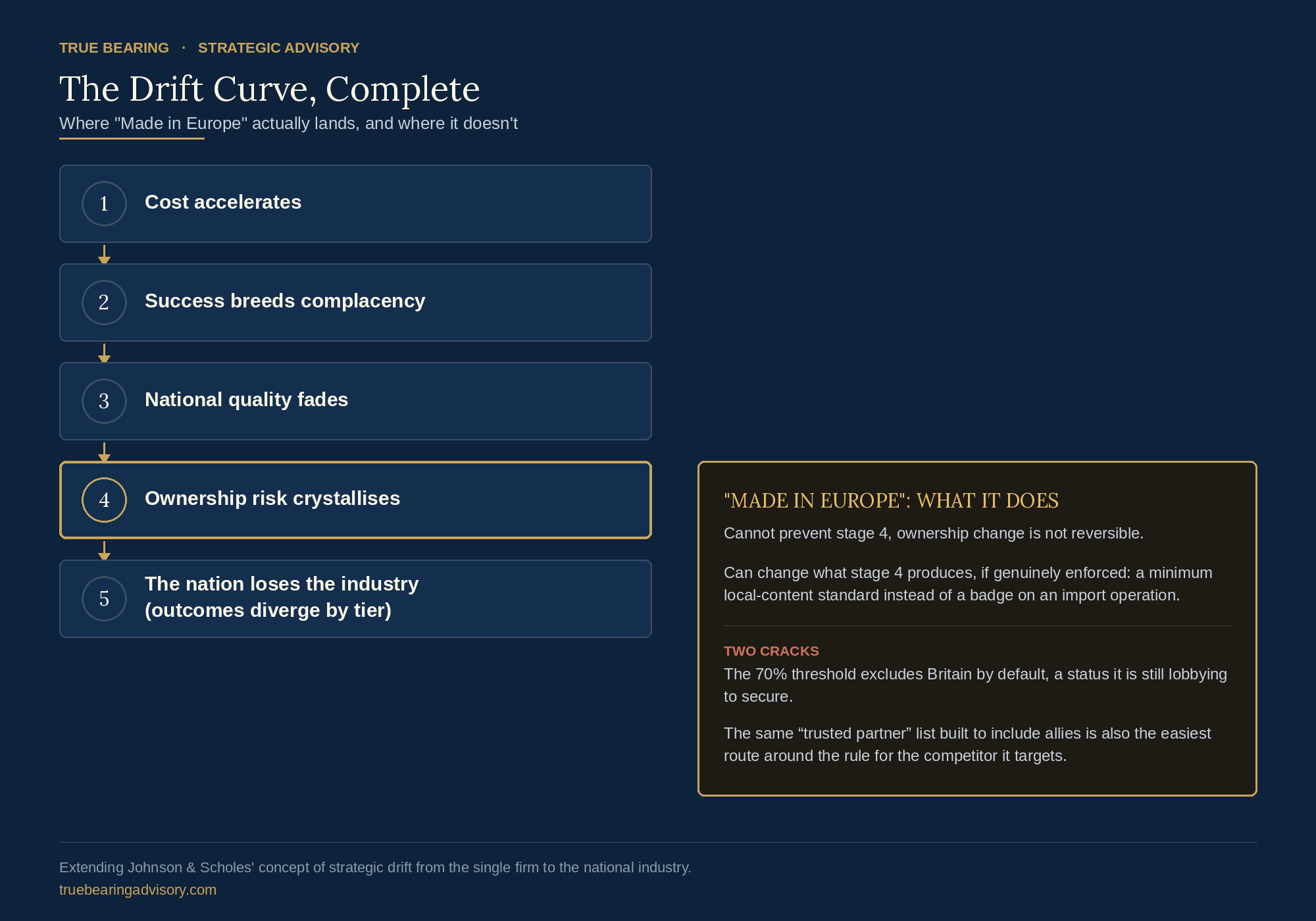
The Drift Curve, complete — where "Made in Europe" lands, and where it doesn't.
The Real Target Is Made in Europe Itself
This is where the Drift Curve resolves into something more specific than a diagnostic. Stage four is ownership risk crystallising. Stage five is the nation losing sovereign decision-making, engineering headquarters functions, and supplier depth, with outcomes then splitting by tier.
“Made in Europe” does not prevent stage four. Chinese capital is already inside the continent's automotive industry, and that is not reversing. What it can do, where it is genuinely enforced rather than narrowly scoped, is change what stage four is permitted to produce, insisting that ownership change comes with genuine local content, employment, and industrial commitment rather than a badge on an import operation. That mechanism is already shaping a real transaction, SAIC has committed that a very significant part of its new Galicia plant's supply chain will be of European origin, specifically because a minimum local-content standard is moving toward adoption. Whether that standard ends up covering the whole market or only a narrow procurement slice will determine how much it actually achieves, and that outcome is not yet settled.
Even genuine enforcement has two structural cracks. The first is who counts as European at all. The 70% content threshold treats Britain, outside the EU since Brexit, as excluded by default, the same Britain whose own stage-five loss opened this series. London is lobbying for inclusion as one of a list of “trusted partners” that runs anywhere from two dozen to roughly seventy countries depending on which track of the rule applies, a status not yet secured. The second crack is larger than the first. The same trusted-partner list built to let allies count as European is also the easiest route around the rule for the one country it was built to exclude. Chinese manufacturers can invest in or route components through Turkey, Vietnam, South Korea, and dozens of other partner countries to gain equivalent-origin status without the ownership conditions attached to direct EU investment. The people who designed the mechanism admit as much: enforcement only catches this after the fact, country by country, through the slow political process of stripping trusted-partner status once a channel is already proven. A standard with a large, loosely policed back door is not the same thing as a standard.
This is specifically aimed at the true-volume tier, the one tier where Britain's and Sweden's version of stage five meant near-total, permanent loss. Germany does not have Britain's twenty years or Sweden's three. It is currently moving through stages one to three simultaneously, not yet locked into stage four. That timing gap is Germany's actual advantage, and it is only real if the mechanism that exploits it is used, at real scale, before the window closes.
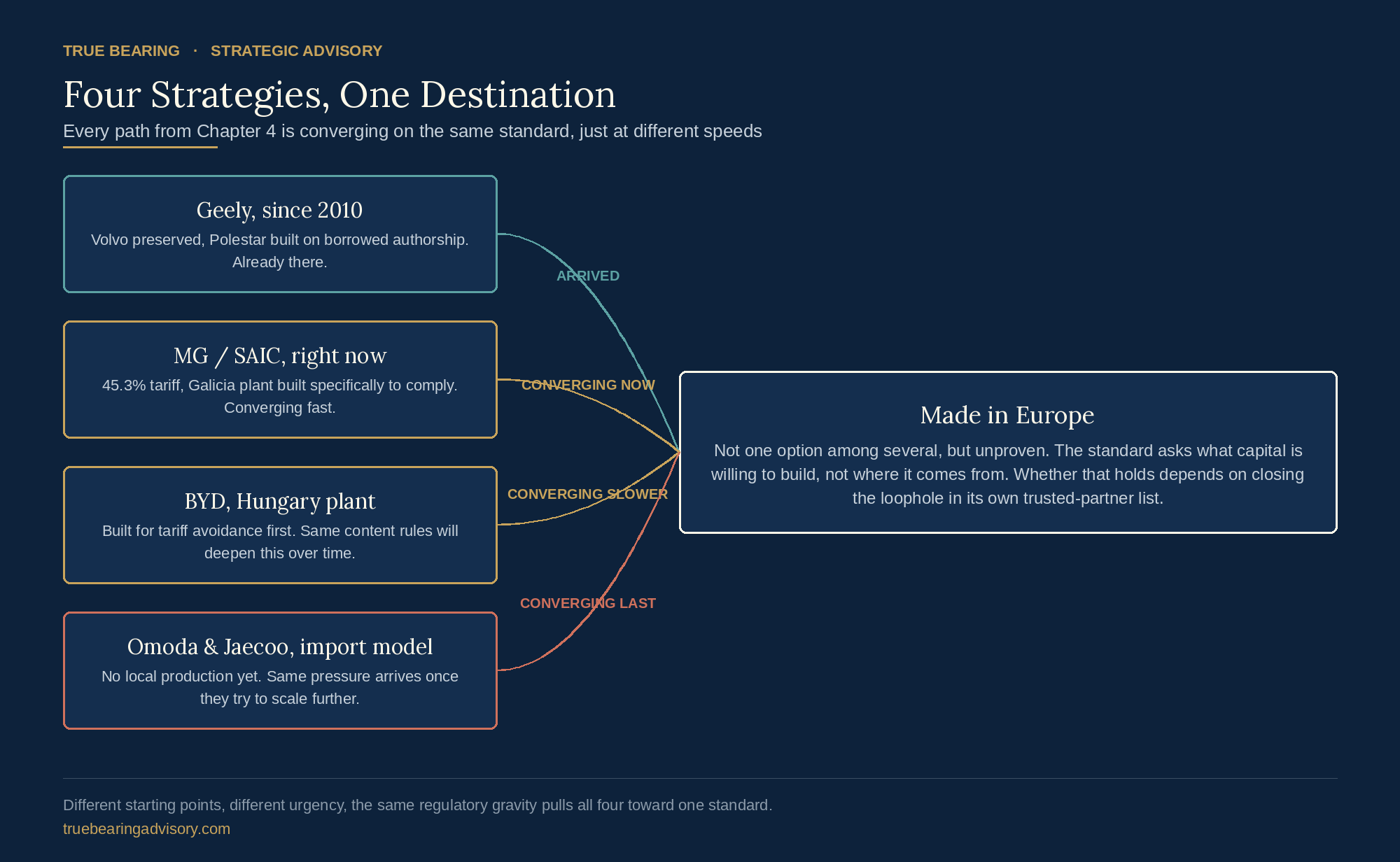
Four strategies, one destination — every path from Chapter 4 is converging on an unproven standard.
Constructive, Not Adversarial
Geely has spent fifteen years proving the constructive model works, Volvo preserved, Polestar built on borrowed Swedish authorship, a stake in Aston Martin positioning Geely as a mentor for a brand this series showed lacked one. MG's Galicia plant is that same logic playing out today, under a regulation not yet finalised. Every strategy in Chapter 4, Geely's already arrived, MG's converging under existential pressure, BYD's converging more slowly as its Hungary plant deepens local content over time, even the pure-import model eventually facing the same pressure once it tries to scale, is being pulled toward the same standard. None of that required treating Chinese capital as an adversary. It required a standard disciplined enough that only genuine, committed capital could clear it.

Direction first. Then movement.
True Bearing
This series tested one framework against real evidence across seven chapters, and it held. Cost accelerates before anyone chooses to see it. Success breeds complacency. National quality fades. Ownership risk crystallises. And the nation loses the industry, though outcomes diverge sharply by tier.
What this series cannot honestly promise is that Germany's outcome is decided. The levers inside the industry's own control, consolidation, composition, mentorship, ending duplicated cost, are real and available regardless of what happens next, and pulling them changes a company's position on the curve today.
What sits beyond the industry's control deserves the same five-stage test this series has applied to companies and countries throughout, because Brussels is not standing outside this pattern. It is arguably several stages into its own version of it. Cost accelerated first: each new regulatory instrument, Block Exemption, Euro 6, the 2035 mandate, the agency model, the Industrial Accelerator Act, added compliance cost the Commission never matched with capital. Success bred its own complacency: decades of steering the market through standards worked while Europe held the advantage, and that success left Brussels reaching for the same tool against a competitor built on integrated, subsidised manufacturing the tool was never designed to counter. Credibility has already started to fade, the way national quality faded in Britain and Sweden: the 2035 target cut from a full mandate to a 90% reduction within months, the steel-origin requirement dropped before this series went to press. Ownership risk, at this level, is the question of who actually decides, and that question is live: a trusted-partner list built to include allies is also the easiest route around the rule for the competitor it was built to exclude, and a Commission that can only strip that status after the fact is not fully in control of its own mechanism. And the outcome is already splitting by tier the way it always does at stage five: Hungary hosting the capital nobody else will take, under legal and political challenge in the same country making it work, Germany fighting to hold what premium and engineering position it has left, volume manufacturing moving regardless of what gets legislated in Brussels.
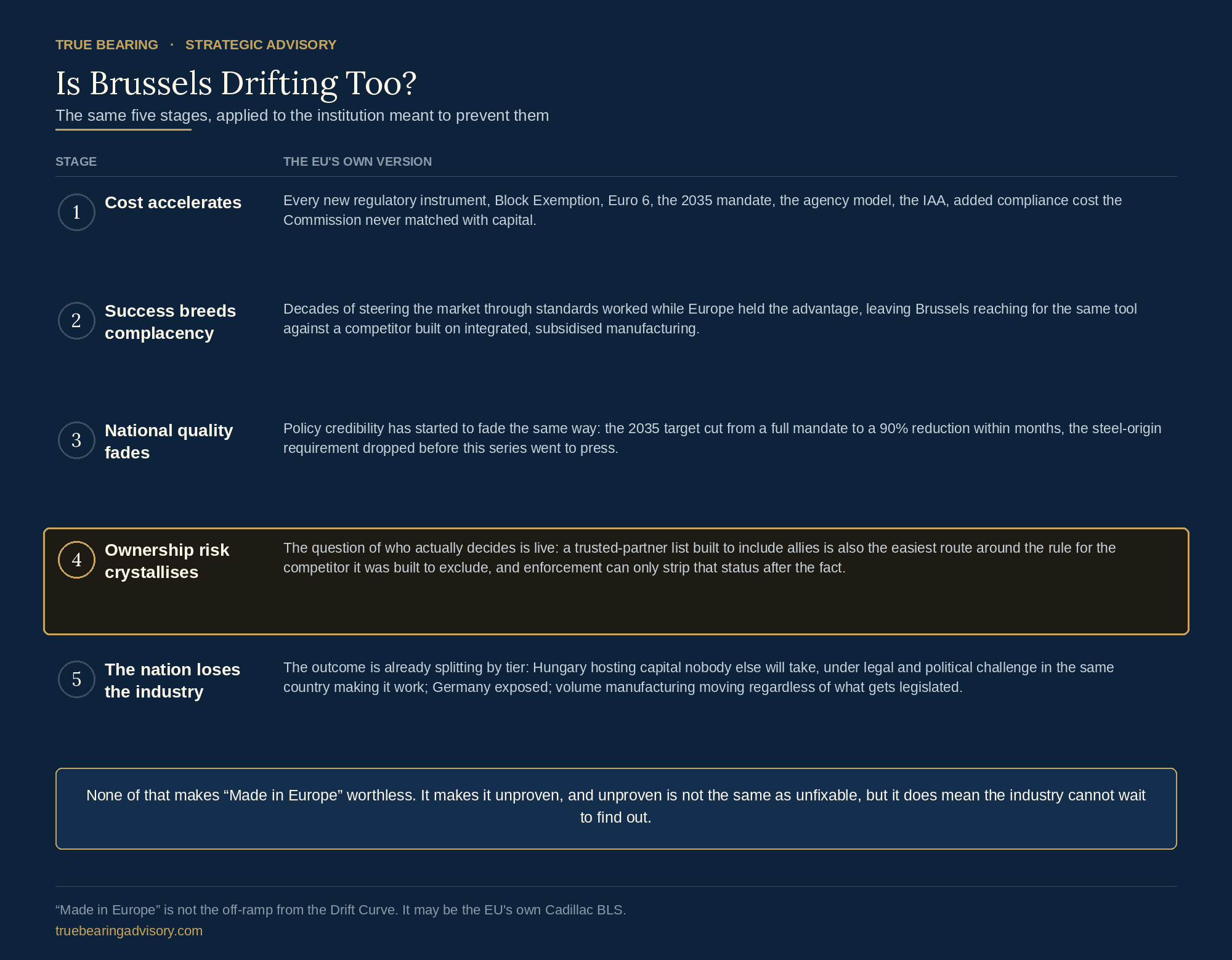
Is Brussels drifting too? The same five stages, applied to the institution meant to prevent them.
None of that makes "Made in Europe" worthless. It makes it unproven, and unproven is not the same as unfixable. It would need to become a real financing instrument rather than a market-access filter, the way the SAFE facility became one for defence. It would need Brussels to retire the regulate-and-not-fund playbook rather than layer another instrument onto it. It would need fewer commitments held without dilution rather than large ones watered down within the year. It would need the trusted-partner loophole closed with verification in advance rather than exclusion after the damage is done. And it would need Hungary's standoff between local consent and strategic siting resolved as the test case for whether this can work anywhere at all.
Until some of that happens, the industry cannot wait to find out. The levers already named, consolidation, composition, mentorship, ending duplicated R&D, are not one option among several. They are the only thing currently inside anyone's control, on a timeline that will not wait for an institution to finish deciding what it actually is. Germany has a timing advantage Britain and Sweden never had. Whether that advantage is used is a decision that has not yet been made, by Brussels or by the industry itself.
This is the tool True Bearing built to make that diagnosis, for OEMs choosing which strategy to bet on, for suppliers and investors reading where distressed capital should already be looking, for boards testing whether their own brand carries real equity, for retail groups deciding whether they have the composition that survives, and for anyone allocating capital into a sector where not everything can be financed at once. The Drift Curve does not predict where any single company or country ends up. It shows which stage they are in, and how much runway remains before the next one begins.
If you are an OEM board reading Chapter 2 as your own strategic choice, a supplier or investor reading Chapter 3 as a map of where distress is concentrating, a brand owner testing Chapter 4 against your own equity, a retail group testing Chapter 5's composition question, or a capital allocator weighing Chapter 6's trade-offs, this diagnostic exists to be used, not just read. If you want to know where your own business sits on the Drift Curve, and how much runway remains, let's talk. truebearingadvisory.com
Balázs Roóz
Founder, True Bearing Advisory
Strategic Advisory · Munich & Limassol