

Funding the Fire
The industry is paying for its own transformation with the revenue that transformation is destroying.

Every strategy is only as real as the capital structure funding it.
I spent years working across the order-to-cash architecture governing roughly £22 billion in annual revenue at Jaguar Land Rover, the system through which every strategic decision eventually became either a payment or a shortfall. I later co-owned a European financial services re-tendering exercise, managing the pitch process across five providers, leading commercial negotiation, and structuring the full deal, which delivered over €100 million in savings over the contract period. Both roles taught me the same lesson from different angles: strategy is only ever as real as the capital structure funding it. Everything this series has covered so far, the OEM strategies in Chapter 2, the supplier distress in Chapter 3, the brand economics in Chapter 4, the retail sorting mechanism in Chapter 5, all of it ultimately reduces to one question. Where is the money actually coming from, and is there enough of it?
The honest answer, laid out plainly, is that every region that was supposed to fund this transition is compressing at the same time.
The Financial Picture, Region by Region
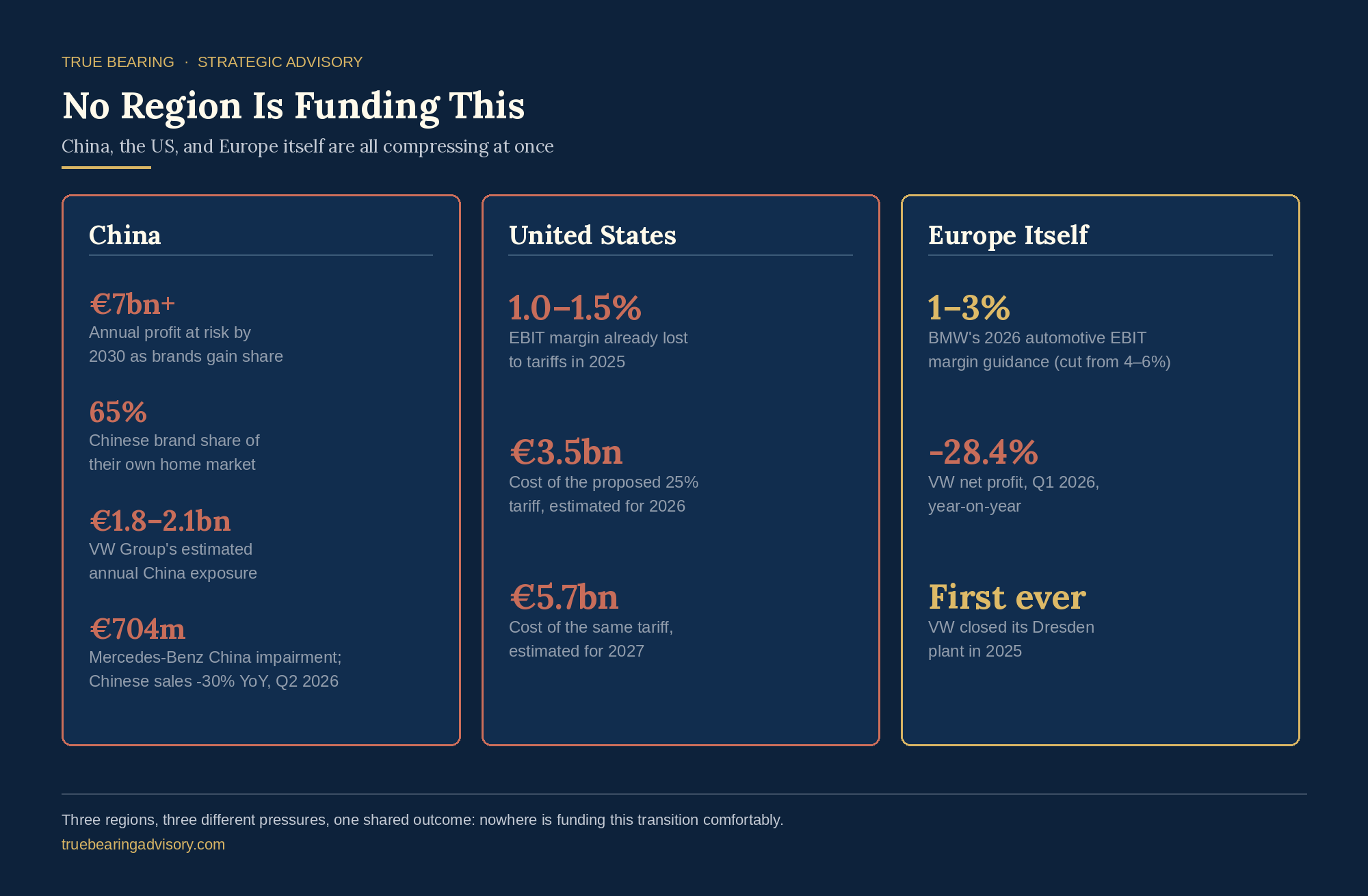
No region is funding this — China, the US, and Europe itself are all compressing at once.
Start with China. Allianz estimates European carmakers could lose more than €7 billion in annual net profit by 2030 as domestic Chinese brands continue gaining share, brands that already hold roughly 65% of their own home market, cutting foreign incumbents down to about a third. Volkswagen Group carries the highest modelled exposure here, an estimated €1.8–2.1 billion in annual China profit at risk, consistent with its position as the most China-dependent European OEM. Mercedes-Benz is not far behind: Chinese sales fell roughly 30% year-on-year in the second quarter of 2026, forcing a €704 million non-cash impairment on its Chinese business and pulling first-half automotive free cash flow down by around 30%.
Then there is the price and volume pressure Chinese entrants are exerting inside Europe's mass-market segment specifically, distinct from the outright price war raging in their home market. Tariffs of up to 35.3% and an emerging EU minimum-price mechanism are working largely as intended at the premium end, BMW raised its Neue Klasse iX3 price by €2,000 shortly after launch on healthy order intake, but the pressure is real and visible in the affordable segment, where Chinese entrants have already topped UK sales charts through heavy discounting and forced a broader race toward sub-€30,000 EVs. If Chinese vehicle imports reach 1.5 million units by 2030, Allianz estimates a €24.2 billion annual value-added impact across the European industrial base, weaker domestic production, thinner margins, spillover through the entire supply chain. BYD, the strongest and most sophisticated Chinese entrant, has posted four consecutive quarterly profit declines pursuing an unrestrained version of this strategy at home, evidence that the underlying approach is punishing even its architects. Sector-wide, European car-sector EBIT margins fell from roughly 7% in 2024 to about 4% in 2025, according to Scope Ratings, while globally, OEM EBITDA margins fell from around 11% to below 8% over a similar window, different metrics, different scope, same direction.
Add US tariffs. Scope Ratings estimates tariff pressure alone cut European sector EBIT margins by 1.0–1.5 percentage points during 2025, with a proposed 25% tariff on EU-made vehicles threatening to push that further for a full year. Analysts put the cost at roughly €3.5 billion in 2026 and €5.7 billion in 2027, with Volkswagen, Porsche, and Audi among the most exposed, given comparatively thin US production capacity. Stellantis is largely shielded, having committed $13 billion (approximately €12 billion) to expand US production by half over four years specifically to avoid this exposure. Renault is effectively insulated, since it doesn't sell in the US at all, one more data point consistent with the different strategic paths Chapter 2 already identified.
Add the agency model's three-year limbo, covered in full in Chapter 5, years of preparation cost paid by retail regardless of whether the transition ever completes.
And then the finding that closes the loop entirely: Europe itself, the region that was supposed to be the stable base funding everything else, is compressing too. BMW's 2026 automotive EBIT margin guidance has fallen as low as 1%, within a 1–3% corridor cut from an original 4–6%, explicitly attributed to China, competition, and geopolitical strain, not a regional problem, a structural one. First-quarter 2026 results show Volkswagen's net profit down 28.4% year-on-year, BMW down 23%, Mercedes-Benz down 17.2%, the entire German premium tier compressing simultaneously. European sales did rise nearly 6% in the first half of 2026, but that growth was driven almost entirely by discounted battery electric vehicles, volume bought with margin, not volume reflecting genuine pricing power. And the single most symbolic fact in this whole picture: Volkswagen closed its Dresden factory in 2025, the first plant closure in the company's entire history. Not a supplier. Not a sub-brand. The parent company itself, doing something it has never done before.
There is no region left standing. China is a direct loss. The US carries tariff exposure. Europe is compressing through exactly the discount-driven mechanism Chapter 4 already diagnosed as unsustainable even for BYD.
The Capital Bill, and What It Actually Costs to Build
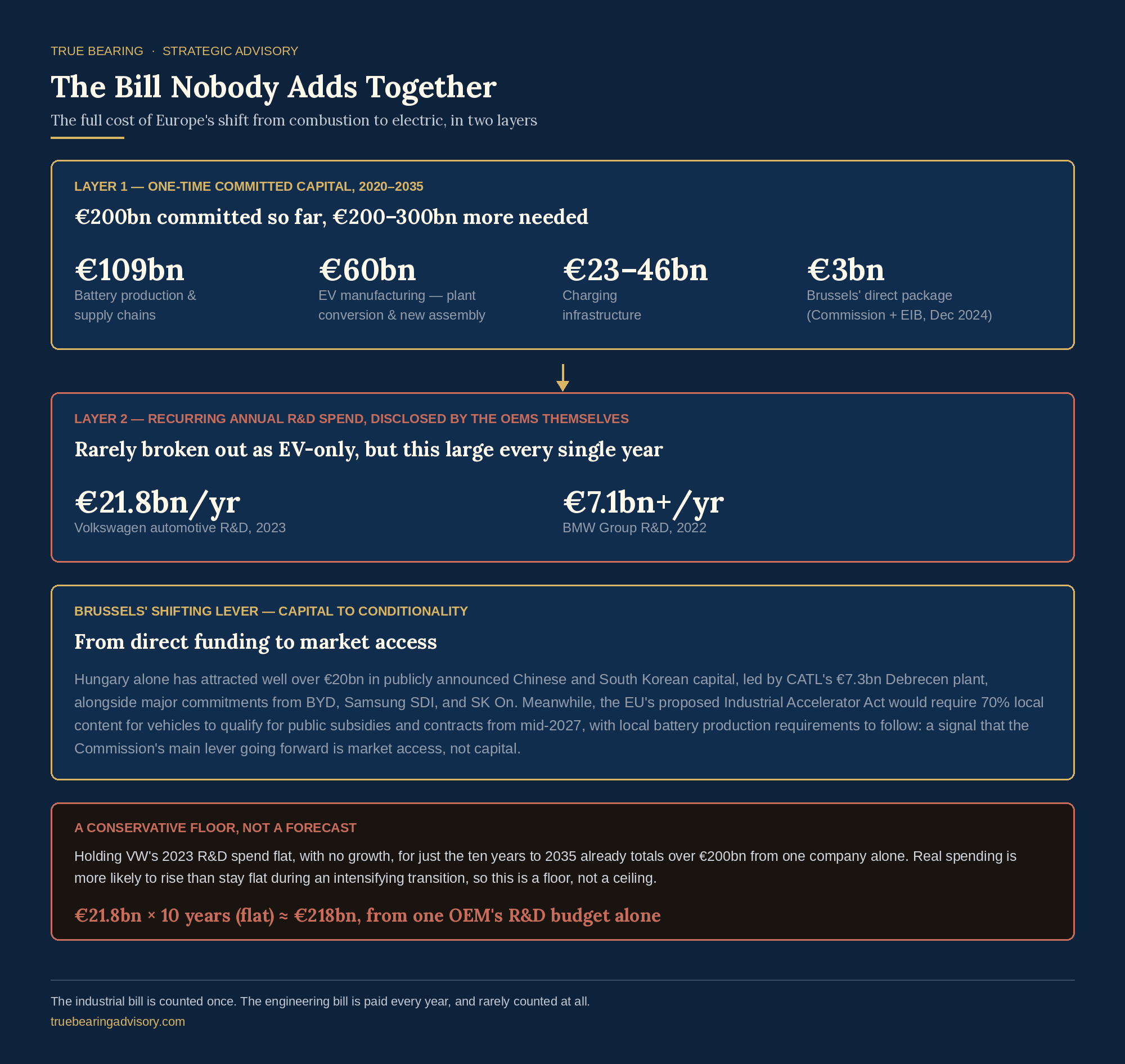
The bill nobody adds together — the full cost of Europe's shift from combustion to electric, in two layers.
Against that backdrop sits the bill for the transition itself, and it is larger than any single headline figure suggests. Roughly €200 billion has been committed to European battery and EV manufacturing capacity since 2020, 80% of it in just the past four years, and McKinsey estimates a further €200–300 billion is needed by 2035 for genuine regional competitiveness. Brussels' own direct commitments amount to a €3 billion package announced by the Commission and EIB in December 2024, Innovation Fund grants, InvestEU guarantees, and envisaged EIB investment, roughly 1–1.5% of the total. Hungary alone has attracted well over €20 billion in publicly announced Chinese and South Korean capital, led by CATL's €7.3 billion Debrecen plant alongside major commitments from BYD, Samsung SDI, and SK On, which is why Hungary, not Germany, is on track to become Europe's leading battery producer this decade. Brussels is also shifting from direct funding toward conditionality: the EU's proposed Industrial Accelerator Act would require 70% local content for vehicles to qualify for public subsidies and contracts from mid-2027, with local battery production requirements to follow, a signal that the Commission's main lever going forward is market access, not capital. The remainder, the largest share by far, is European OEM and supplier balance-sheet spending, arriving at the exact moment those balance sheets are compressing on every front described above.
Layered on top of the industrial capex is the engineering cost nobody separates out cleanly in public disclosure. No European OEM reports a clean “EV-only” R&D figure, but the scale is unmistakable. Volkswagen spends more on R&D than any automaker in the world, €21.8 billion in its automotive division alone in 2023. BMW's R&D exceeded €7.1 billion in 2022, driven substantially by its electric and Neue Klasse programmes. Held flat, with no growth at all, Volkswagen's R&D spend alone would total over €200 billion across just the ten years to 2035, a conservative floor, not a forecast, since real spending is more likely to rise than stay flat as the transition intensifies. The supplier tier is under the same pressure without the same balance sheet to absorb it: European suppliers are running EBIT margins of roughly 3.6%, against 5.7% for their Chinese counterparts, and in Germany specifically, nearly one in six major corporate insolvencies in the first half of 2025 involved an automotive supplier.
The industrial capacity bill is roughly €200–500 billion through 2035. The engineering bill sitting on top of it runs into tens of billions annually at the largest OEMs alone, and unlike the industrial bill, it is paid every single year, not committed once. Regardless of who ultimately builds the batteries, the core engineering transformation has to be funded from the same operating margins this chapter has just shown compressing in every region simultaneously.
The Trade-Off, and It Is Already Being Made
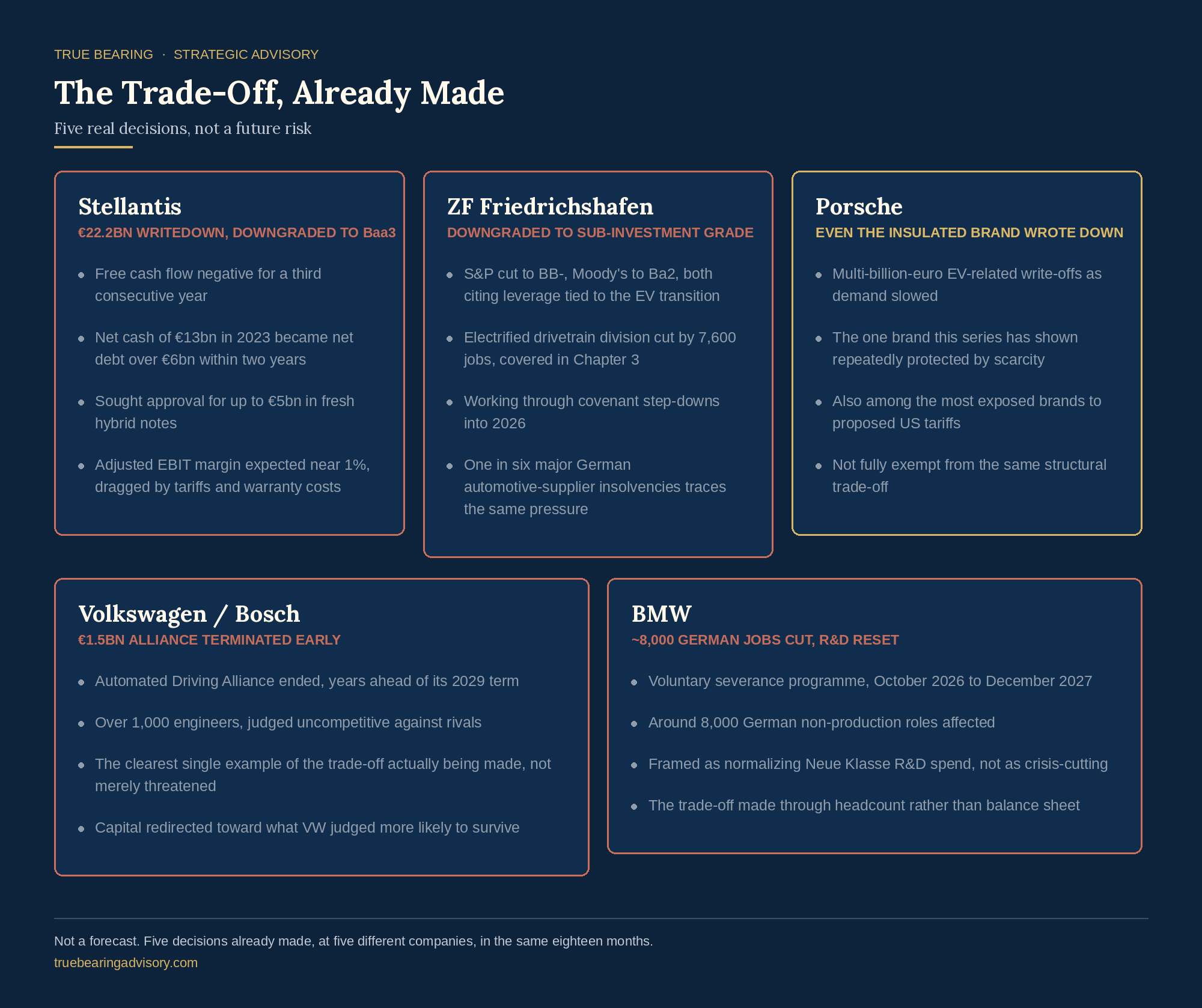
The trade-off, already made — four real decisions, not a future risk.
This is not a financing gap that resolves itself with patience. It is a trade-off being made inside real boardrooms right now, and the evidence is already public. Stellantis's own EV strategy reset triggered roughly €22.2 billion in writedowns, pushed free cash flow negative for a third consecutive year, and swung the company from €13 billion in net cash to over €6 billion in net debt in two years. Moody's downgraded Stellantis to Baa3, the lowest rung still inside investment grade, directly citing the cost of that reset, and the company sought board approval for up to €5 billion in fresh hybrid notes, debt raised specifically to fund a transition the operating margin could no longer cover alone. ZF, whose electrified drivetrain division was cut by 7,600 jobs in Chapter 3, has been downgraded to sub-investment grade entirely. Even Porsche, the one brand this series has repeatedly shown insulated by scarcity and pricing power, recorded multi-billion-euro EV-related write-offs as it reassessed its own electrification pace against slower-than-expected demand. Not even the strongest brand in this series is fully exempt from the trade-off. BMW has made the same trade-off through headcount rather than balance sheet: a voluntary severance programme cutting around 8,000 German non-production jobs between October 2026 and December 2027, framed less as crisis-cutting than as normalizing Neue Klasse R&D spend now that the platform's initial technological leap is behind it.
The clearest single example of the trade-off actually being made, rather than merely threatened, is Volkswagen's own decision to terminate its Automated Driving Alliance with Bosch, confirmed in July 2026. A five-year, roughly €1.5 billion software partnership, over 1,000 engineers, killed years ahead of its planned 2029 end date, because VW's own internal assessment found the resulting technology uncompetitive and the company could no longer afford to keep funding an underperforming bet while the core transition, batteries, platforms, the model-lineup cuts already covered earlier in this series, demanded every euro of capital discipline available. There is no version of Volkswagen's current position where every commitment survives. Something has to be cut to fund what matters more, and increasingly, that decision is being made in public, one abandoned partnership and one cancelled model line at a time.

Not every euro can be spent twice. The choice is already being made.
None of this is a temporary financing gap waiting for conditions to improve. It is the structural reality of an industry being asked to fund the largest technology transition in its history using revenue streams that the transition itself is actively destroying, in China, in the European price war, against US tariffs, and now inside Europe's own core market as well. The companies making the sharpest, earliest trade-offs, Stellantis absorbing its writedowns and raising fresh debt, Volkswagen killing an underperforming partnership rather than continuing to fund it, are not failing more than their peers. They are simply the first to admit publicly what this chapter has shown is already true everywhere: not everything can be financed, and the decision about what gets cut to fund what survives is no longer theoretical.
The next and final question in this series is whether Europe has an option Britain and Sweden never had, a way to fund this transition collectively rather than company by company, country by country, each absorbing the same pressure alone.
If this pattern is already playing out inside your own organisation, market, or portfolio, I'd welcome the conversation. truebearingadvisory.com
Balázs Roóz
Founder, True Bearing Advisory
Strategic Advisory · Munich & Limassol