

The Silent Casualty
Retail fought the wrong battle, and capital decided the outcome anyway.

The relationship is the product. It cannot be standardised at scale.
Over my career I have operated most of this industry's routes to market, and said no to one of them. Agency works when you are selling a commodity, standardised product, standardised price, a relationship between brand and customer that is transactional and interchangeable. Luxury cannot work that way. It requires something closer to a concierge relationship, one to one, personal, and at the scale a European or global rollout demands, that cannot be delivered consistently through a fixed-price, fixed-commission structure. Technology can enable that relationship, but it is not, on its own, the answer in this space. That is not a footnote. It is a precondition. Thin air, the pricing power Chapter 2 described, does not exist without it. Scarcity alone does not create a premium. The relationship that justifies the price does.
But the argument over retail's structure, who controls it, agency or franchise, is not the story this chapter is actually about. That fight is forty years old, and it has never once changed who wins.
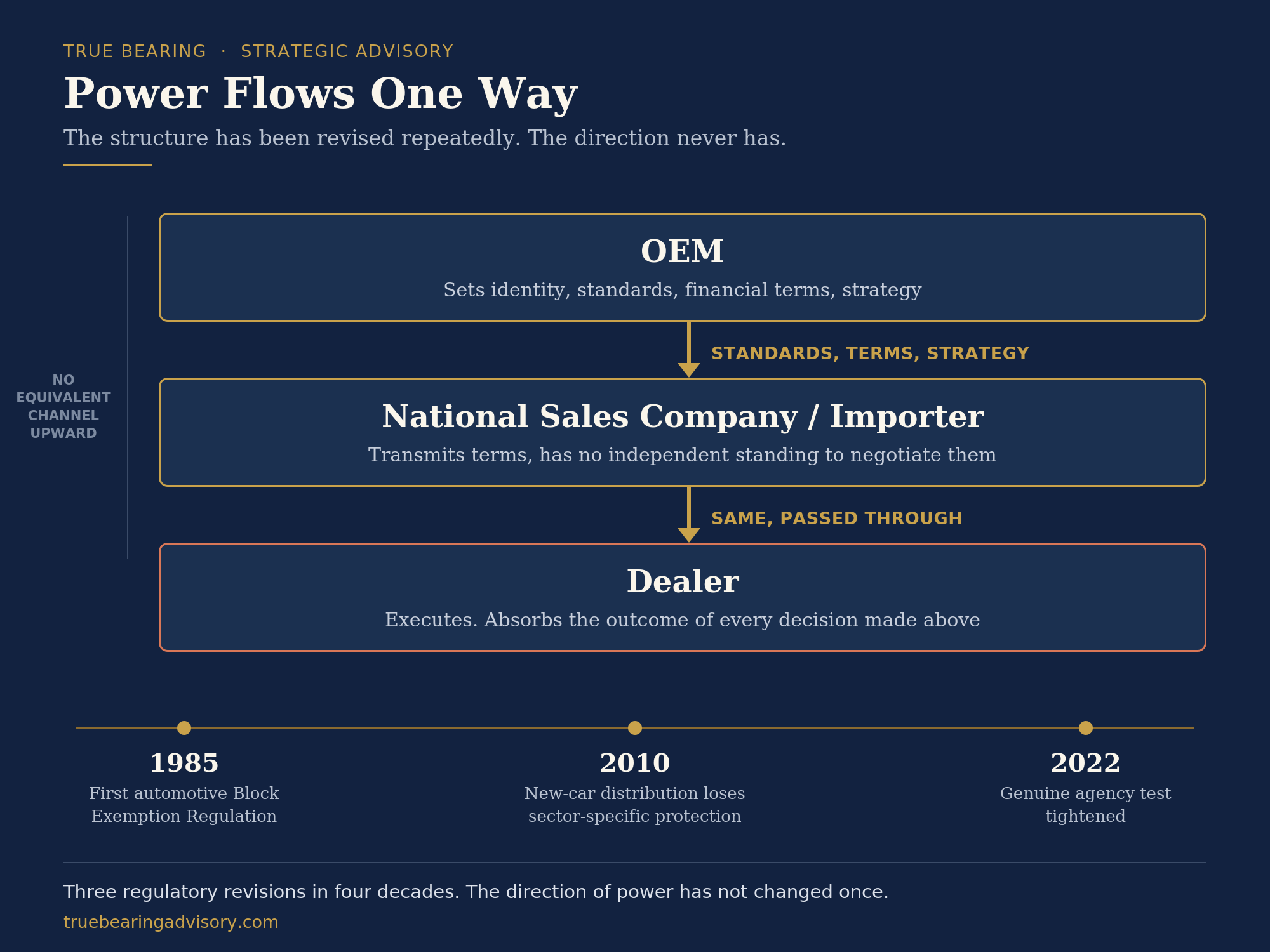
Power flows one way - the structure has been revised repeatedly, the direction never has.
The structure is old. An OEM working through a national sales company into a dealer network predates European competition law entirely, was formally protected under a dedicated legal exemption from 1985, and has been revised roughly every decade since, losing its special sector-specific protection for new car distribution in 2010. In 2022, the rules changed again, and specifically against agency: the EU narrowed the legal definition of a genuine agent, tightening the test an OEM must pass to reclassify its dealers without falling foul of competition law. What survived every revision, including this one, is the power direction. The OEM sets identity, standards, financial terms, and strategy, and pushes all of it down the chain. The dealer executes. Every other consumer-facing industry has had that structure broken open by disruption at least once. Automotive retail has absorbed three attempts, the 1970s crisis, online and direct-sale models in the 2010s, and the current agency and Chinese-entrant pressure, without the direction of power ever actually reversing. Three formal legal revisions in four decades, and the outcome for whoever is standing at the bottom of the chain has never once changed.
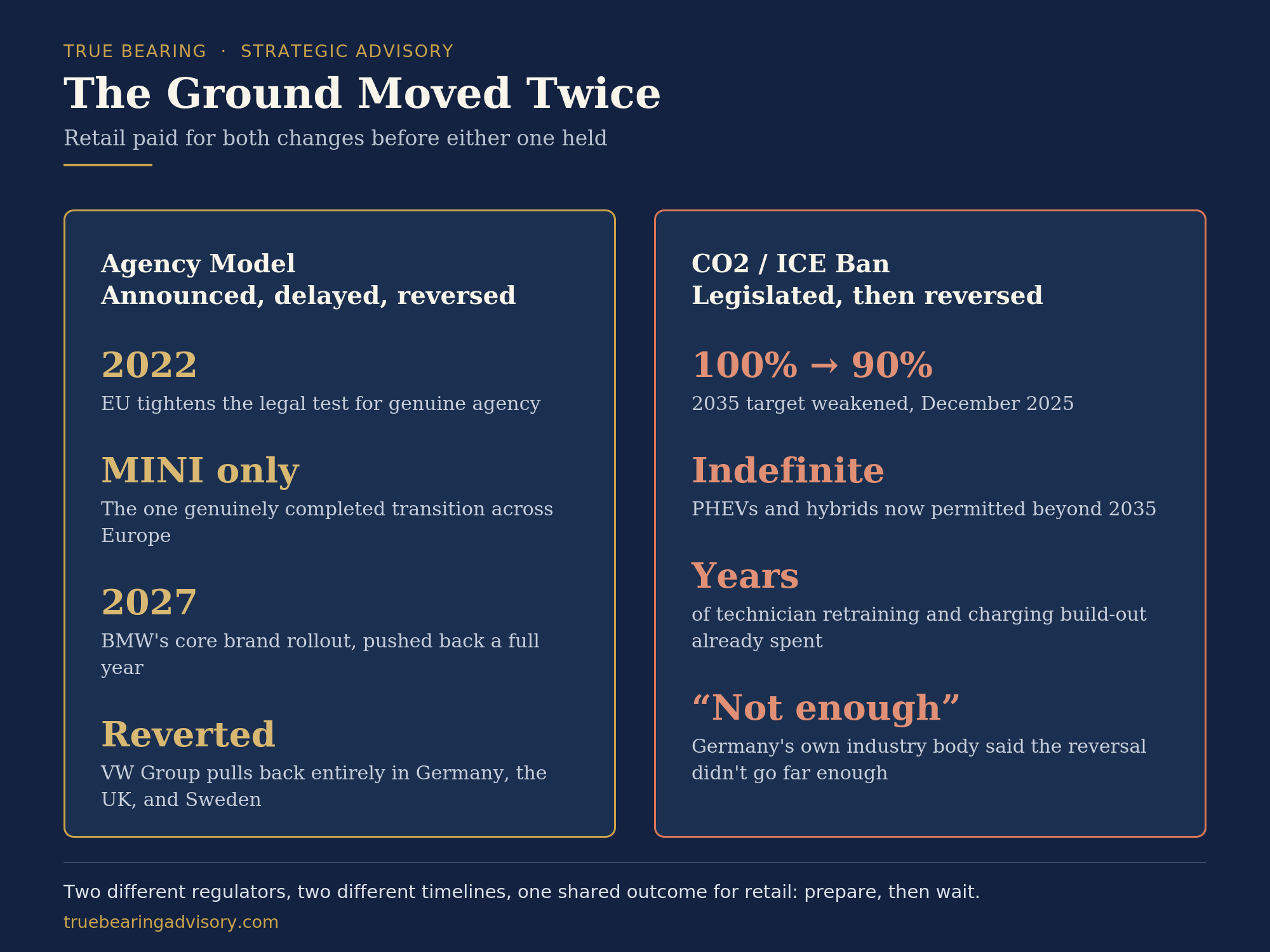
The ground moved twice - retail paid for both changes before either one held.
That is worth holding in mind, because the ground has kept moving under retail regardless. The 2022 tightening explains why agency has stalled almost everywhere at once. MINI remains the only genuinely completed transition. BMW's core rollout, originally planned for early 2026 across Germany, France, and the UK, is now pushed to 2027. Mercedes has delayed its Spanish rollout repeatedly. Stellantis suspended its own restructuring after dealer protest. VW Group reverted entirely in Germany, the UK, and Sweden. Dealers have spent three years training staff, restructuring legal entities, and preparing systems for a transition that keeps almost happening.
The ground moved a second time, on a different axis entirely. On 16 December 2025, the European Commission proposed reversing the 2035 combustion engine ban, weakening the legislated 100% CO2 reduction target to 90%, with the remaining 10% offset through EU-made low-carbon steel or sustainable fuels rather than eliminated outright. In practice, this reopens meaningful room for plug-in hybrids, range extenders, and combustion vehicles to remain part of an OEM's mix past 2035, not unconstrained, but real. The proposal still requires European Parliament and Council approval, though analysts consider passage likely given the political pressure behind it, pressure that came directly from Germany and Italy's governments, with Germany's own auto association saying even this reversal didn't go far enough. Retail networks had already spent years and real capital retraining technicians, converting workshops, and building charging infrastructure, against a regulatory floor that just moved beneath them regardless of how the final detail settles. ZF's own pivot from battery-electric to plug-in hybrid drivetrain development, described earlier in this series, now reads as a supplier correctly anticipating a shift that had not yet happened. Suppliers paid the direct price for that uncertainty from one end of the value chain. Retail paid the indirect price for it from the other.
Neither of these fights, structural or regulatory, is what decides who survives. They are both proof that retail cannot wait for the ground to stop moving before acting, because it never does.
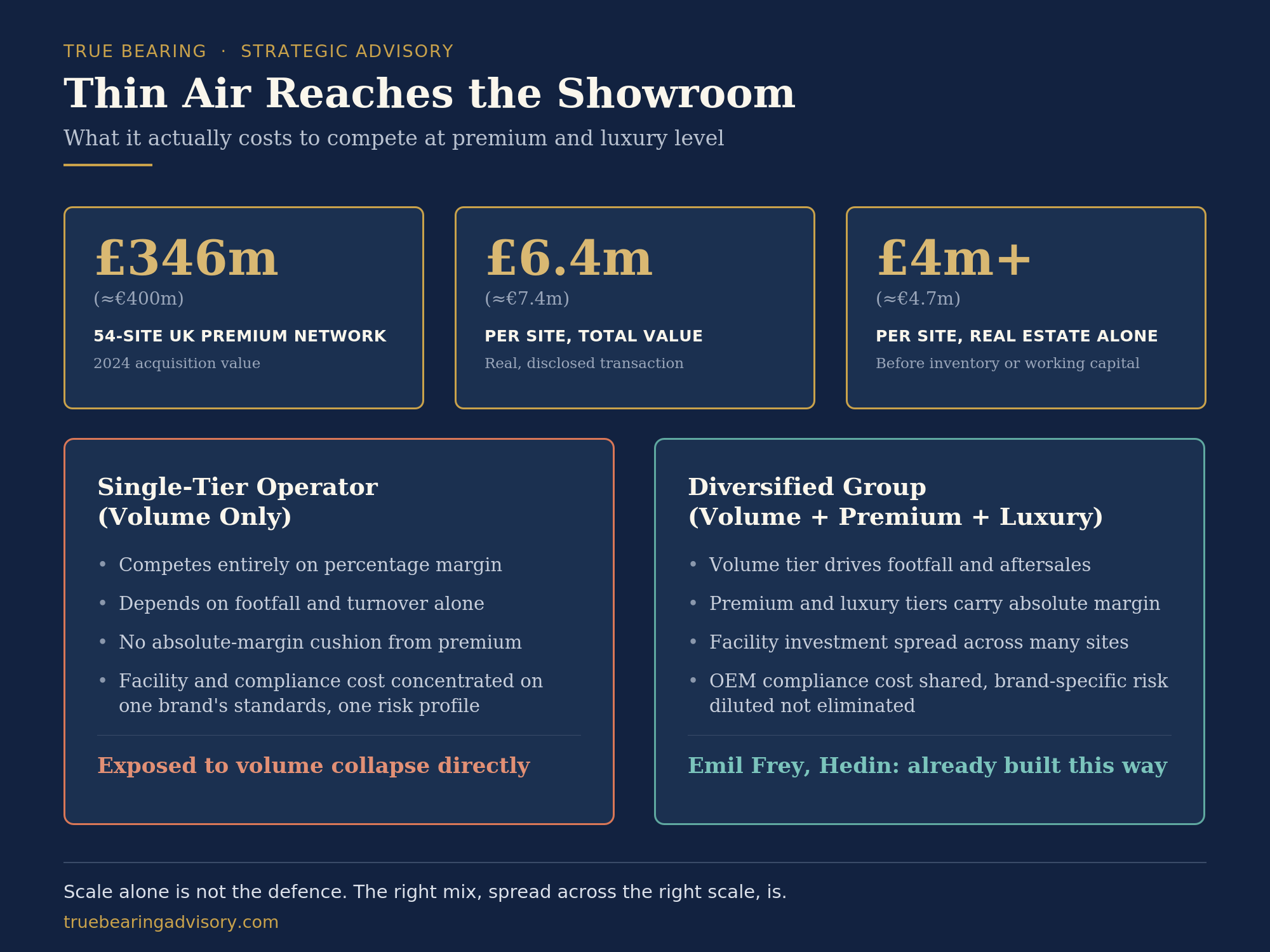
Thin air reaches the showroom - what it actually costs to compete at premium and luxury level.
The actual sorting mechanism is capital, and it runs directly through the same thin-air logic Chapter 2 described from the OEM side. New car margins are thin as a percentage across the industry, but at premium and luxury level, thin percentages sit on top of high transaction values, and the absolute profit per unit is still substantial. That is exactly why retailers are drawn toward the same premium and luxury zone OEMs are chasing, and why the pull is not irrational. But the retail version of thin air carries an identical structural risk. A premium or luxury franchise requires capital intensity that does not scale down with volume, millions per site in real estate, facility standards, and working capital, concentrated on far fewer transactions than a volume franchise generates. A 2024 acquisition of a 54-site UK premium dealer network, spanning Audi, BMW, Jaguar Land Rover, Mercedes-Benz, and Porsche among others, was valued at roughly £346 million (approximately €400 million), implying close to £6.4 million per site (approximately €7.4 million), with real estate alone accounting for over £4 million of that (approximately €4.7 million) before inventory or working capital. And the department that has traditionally absorbed the fixed costs of running any of this, aftersales, running at roughly five to six times the gross margin of new car sales, is now facing its own structural erosion, since electric vehicles carry meaningfully lower maintenance and repair costs — Ayvens' European TCO research puts the reduction at roughly 11% over a vehicle's first four years.
That is the same mechanism that makes a single strategic misjudgement catastrophic for an OEM operating without a mentor, and it applies just as directly to the dealer holding the franchise. Jaguar's collapse and Volvo's 2025 distress both show that even a strong brand under strong ownership can turn thin margin into real loss with startling speed, and a retailer's investment sits directly exposed to that risk, with none of the control over product, timing, or strategy that caused it. Scale alone does not solve this. The deeper answer is composition. A group holding only volume franchises is competing entirely on percentage margin and footfall. A group holding the right mix of volume, premium, and luxury franchises captures resilient footfall and aftersales volume from the former while extracting real absolute margin from the latter, spreading facility investment and compliance cost across all of them at once. Nobody in this chain, OEM, retailer, or the capital behind either, escapes the trade-off Chapter 2 named first. Thin air is not a safer place to stand anywhere in this value chain. It is where the stakes are magnified for whoever is standing in it.
This is not a contradiction of what this series opened with. Britain lost its manufacturing and engineering sovereignty, the actual subject of Chapter 1. It did not lose its market. The UK remains Europe's second-largest car market today, behind only Germany, and that scale is precisely what built the distribution and retail expertise now sitting among the most sophisticated in Europe. A country can lose the ability to design and build its own cars while retaining, and even strengthening, its ability to sell and service everyone else's. Those are two different capabilities, and Britain's story runs in opposite directions on each of them.
The losing side of this is not hypothetical. It is already measurable. Europe has lost roughly 16% of its dealer outlets over the past decade, and that decline concentrates precisely where the capital bar sits highest relative to scale: France, Poland, and Italy alone are among the hardest-hit markets, and the large consolidator groups now driving this shift already control roughly a third of Europe's franchised dealer network — the deepest small-operator fragmentation risk on the continent. There is no dedicated industry built to manage that decline gently. Auto Wallis shows what the winning side of the same sorting looks like while it is still happening. Unlike Emil Frey's already-established scale — an estimated CHF 16.8 billion in 2024 group revenue — spanning Switzerland, France, Germany, and much of Central and Eastern Europe, Auto Wallis is visibly mid-acquisition right now, absorbing the Milan Kral Group in the Czech Republic, securing exclusive NIO distribution across five Central and Eastern European markets, building a genuinely diversified, cross-border, multi-brand portfolio one deal at a time. Hedin has done the same at larger scale, adding BYD, Hongqi, and Xpeng directly into its existing mix. None of this is accidental. Each is executing the same composition this chapter has been building toward, all along.

Structure didn't decide this. Capital did.
The answer to who survives this was never going to come from outside Europe, and it was never really about agency, or CO2 policy, or any of the fights that made the headlines. It is the groups large enough, and diversified enough, to be on the buying side of that 16%, not the selling side.
Next in this series: the financing question underneath all of it, where the industry is being asked to fund its own transformation with the revenue that transformation is destroying.
If this pattern is already playing out inside your own organisation, market, or portfolio, I'd welcome the conversation. truebearingadvisory.com
Balázs Roóz
Founder, True Bearing Advisory
Strategic Advisory · Munich & Limassol