

The Brand Vacuum
Brand isn't the soft metric in this industry, it's the profit margin.
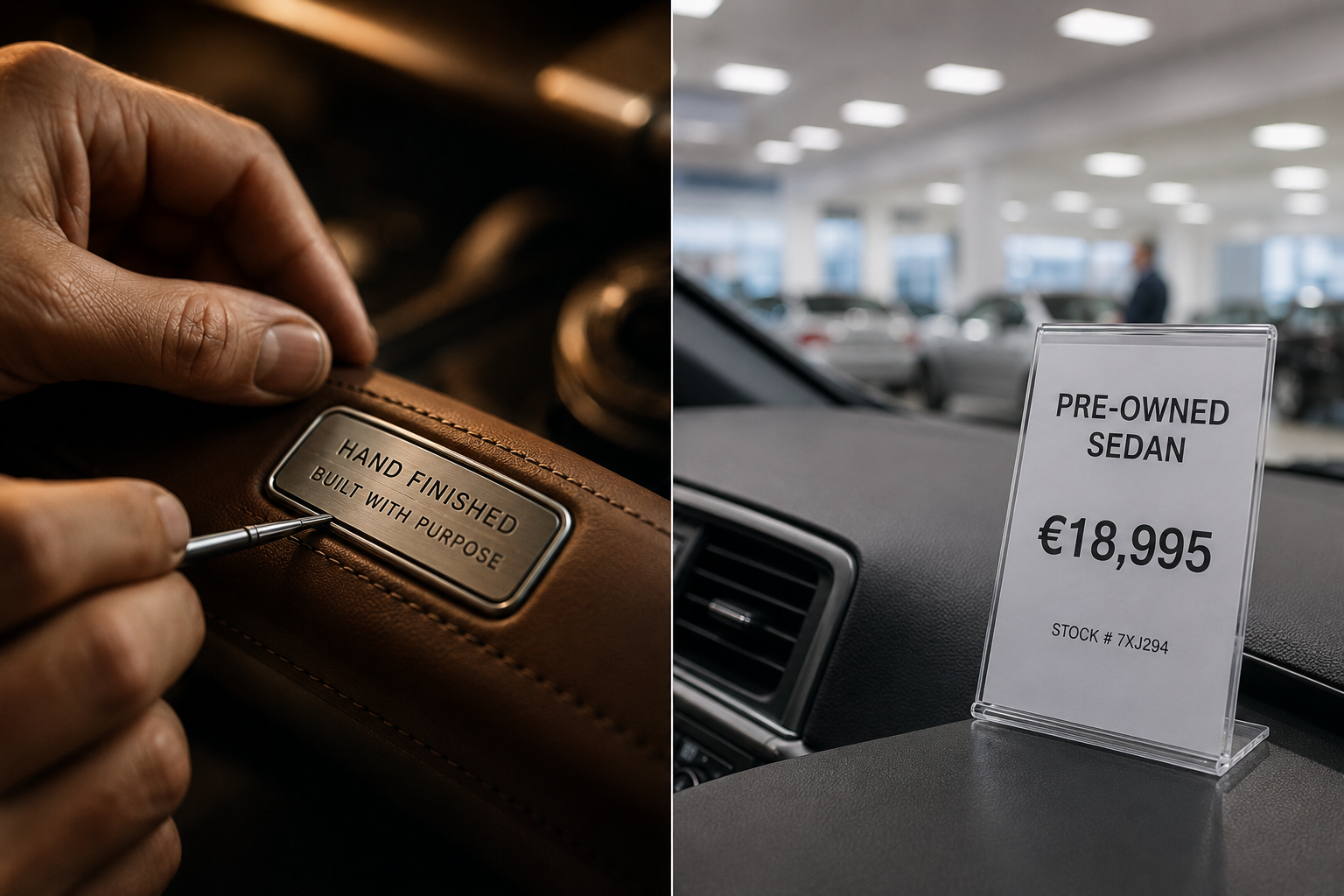
Craftsmanship and a price tag. Only one of them needs no explanation.
At Bentley, I watched brand equity do something no cost efficiency or manufacturing scale could replicate. Two of the company's most profitable years in its history happened during the worst supply chain disruption the industry has seen in a generation, chip shortages, freight chaos, input costs spiking everywhere. Volume fell. Margin didn't. That is not a marketing outcome. It is the mechanism that produces the real numbers, and it raises a question worth testing properly rather than assuming: is brand equity actually what determines success in this industry, or is that just an assumption everyone in automotive carries without examining it?
No Volume Badge Has Ever Bought Premium Pricing
The historical record is remarkably consistent, and it points to something more precise than “brand matters.” No volume badge has ever bought its way into premium pricing quickly, no matter how good the engineering underneath it. Volkswagen's Phaeton was built on the same D1 platform as the Bentley Flying Spur, genuinely the same underlying car, and it still failed almost everywhere, because buyers would not pay six-figure money for a car wearing a Volkswagen badge. Mercedes learned the same lesson twice with Maybach. Launched as a fully independent marque in 2002 to rival Rolls-Royce and Bentley, it failed and was discontinued by 2013. Relaunched in 2015, not as a pretend-independent brand but as an openly badged Mercedes-Benz sub-line, it has sold well since, because it borrows Mercedes' own century of prestige rather than trying to manufacture new prestige from nothing. Infiniti tried the fully independent route in the United States in 1989 and spent 25 years as a permanent also-ran, never cracking Europe before folding the operation entirely in 2020. There is no third option. Either genuine inherited heritage, or openly borrowed equity from a parent that already has real prestige to lend.
Land Rover's own history shows the same rule from the success side, and I have seen it work from the inside. Range Rover was never really a volume brand reaching upward. It was aspirational from its 1970 launch, genuine expedition and military provenance built over five decades before it ever needed to justify a six-figure price tag. That is the mechanism working correctly: decades of earned, organic heritage converting directly into pricing power that no amount of clever engineering alone has ever achieved on its own.
Four Strategies, One Test
Four distinct strategies are now attempting to solve this exact problem for Chinese entrants trying to establish themselves in Europe, and testing the brand equity thesis against all four, rather than just one, is the only honest way to know if it actually holds.
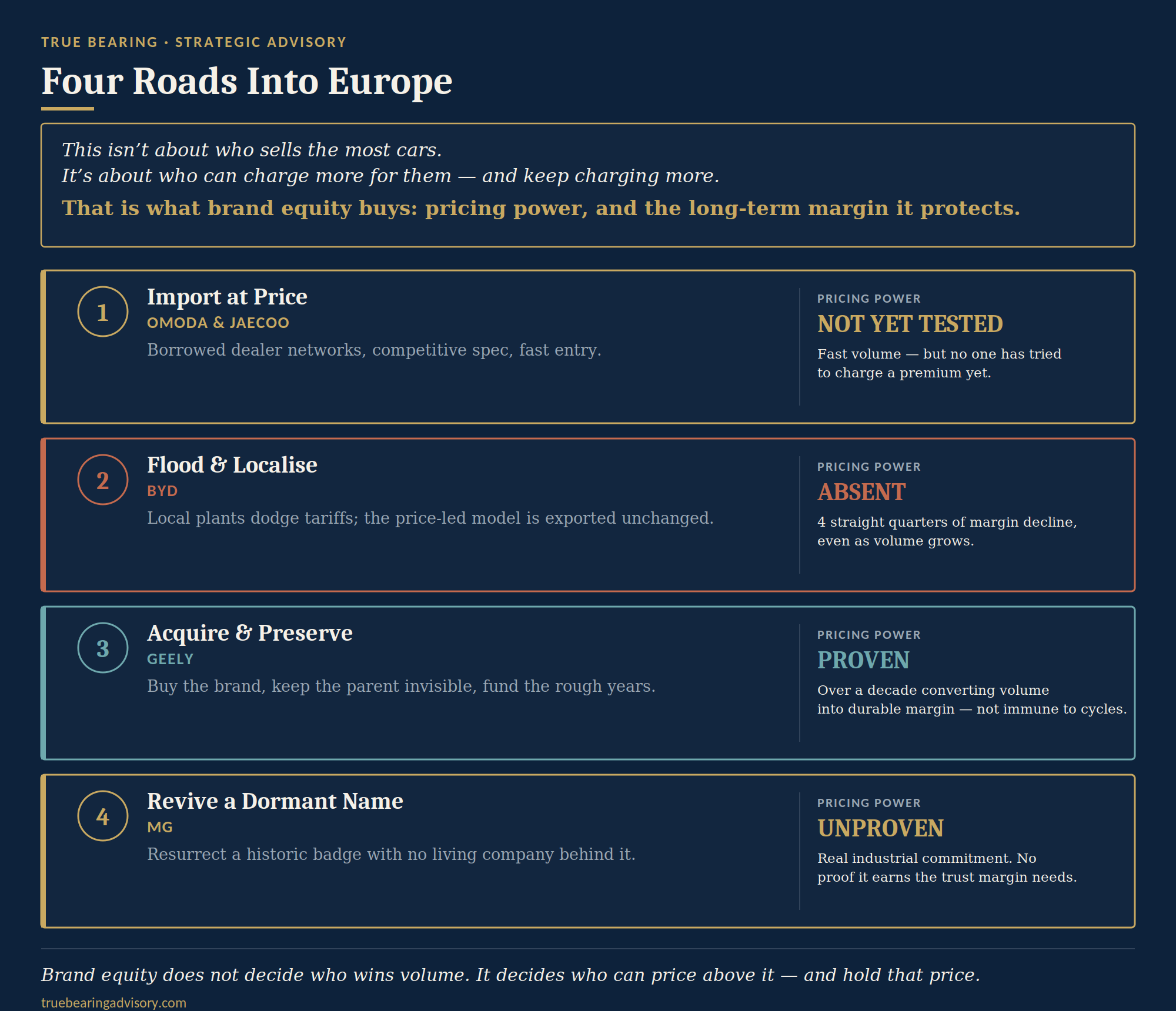
Four roads into Europe — only one has a decade of proof behind it.
Strategy One: Import at Price
The first strategy is import at price and specification, using infrastructure that already exists rather than building anything new. Chery's twin export brands, Omoda and Jaecoo, are the clearest evidence. Genuinely remarkable speed, breaking into the UK's top three best-selling models faster than any brand in automotive history, using dealer networks that were “lined up and ready to go before the cars had even landed,” as one UK retailer put it. But the brand equity thesis predicts a specific limit to this strategy, and the evidence so far is consistent with that limit rather than against it. One reviewer testing the range-topping Omoda 9, a car with genuinely impressive specification, noted that nobody he spoke to had actually heard of the brand, they simply accepted it as “a new Chinese electric model.” That is volume without recognition. It has not yet been tested against a premium price point, because nobody has tried to charge one.
Strategy Two: Flood and Localise
The second strategy is flooding through localised manufacturing, and BYD is both the most aggressive and the most instructive example, because its own numbers are currently the clearest disproof available anywhere in this industry that flooding alone gets you where you need to go. Four consecutive quarterly profit declines, first a 29.9% drop in Q2 2025, then 33.0%, then 38.2%, then 55.4% in Q1 2026, even as European volume grows, sales up over 50,000 units in a single quarter. Local production solves exactly one problem, the tariff wall. It has done nothing for the trust problem, and BYD's own halo product proves it most starkly. At the 2026 Goodwood Festival of Speed, the group's premium sub-brand Denza unveiled the Z, a 1,582 horsepower electric supercar, undercutting the Porsche 911 Carrera 4 GTS on price while claiming nearly triple the power. On paper, an easy sale. In practice, a Porsche badge lets a buyer spend six figures without explaining themselves to anyone. A brand nobody has heard of, sold by a parent with no luxury equity of its own to lend, forces exactly that explanation, however capable the machine underneath. Under-cutting a Porsche by a few thousand pounds does not solve that problem. No spec sheet can.
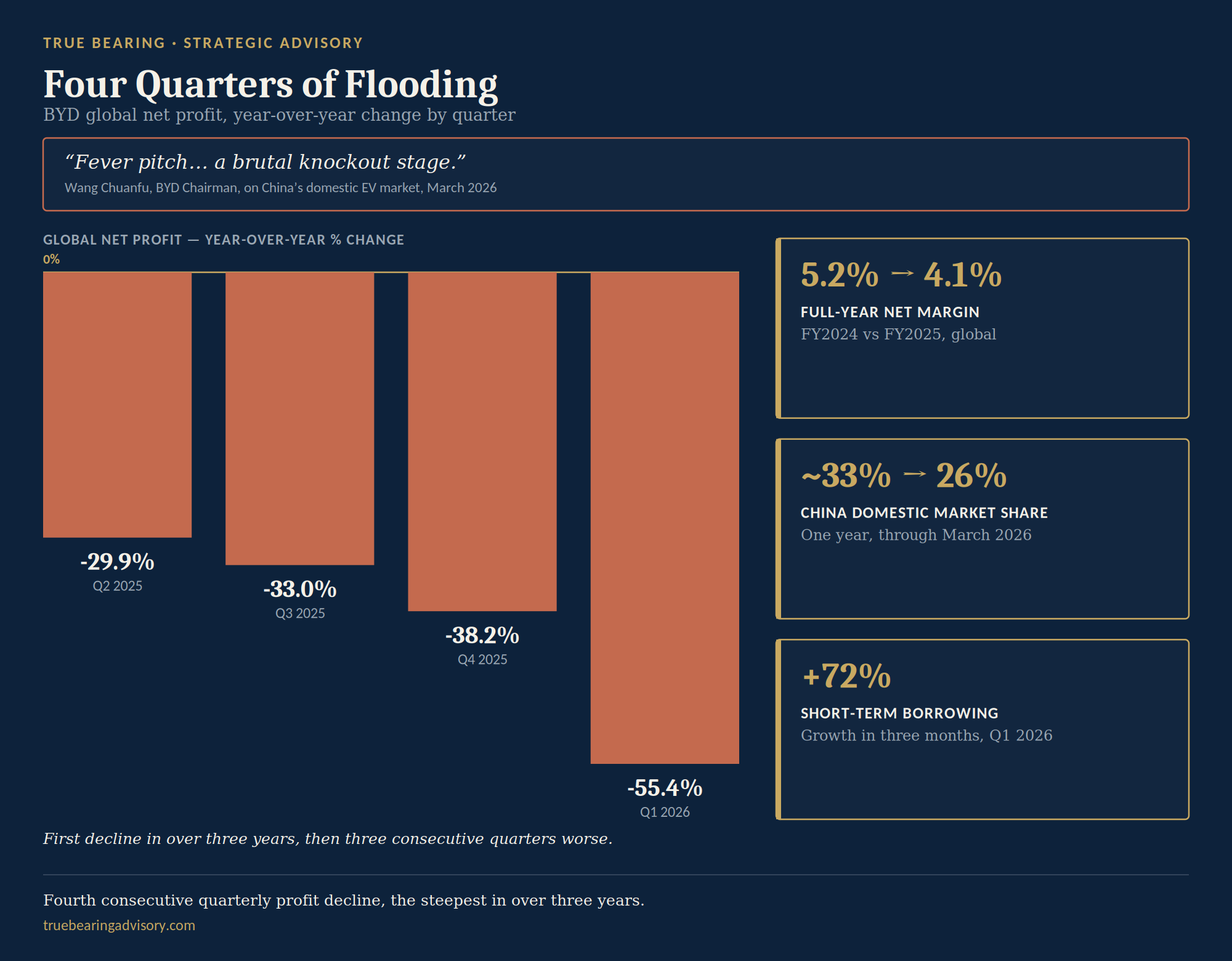
Four quarters of flooding — BYD's own numbers, not ours.
Strategy Three: Acquire and Preserve
The third strategy is acquisition, buying into existing European brands while deliberately keeping investor and brand identity separate, and this is the strategy with an actual decade of proof behind it. Geely's holdings, once mapped out in full, are genuinely startling in scope. Majority control of Volvo Cars since 2010. Roughly 69% beneficial ownership of Polestar. A 51% stake in Lotus. A joint venture with Mercedes-Benz to build the Smart brand. A 17% stake in Aston Martin. And, remarkably, Li Shufu personally holds a 9.69% stake in Daimler AG, Mercedes-Benz's own parent company, making him its single largest shareholder. Geely also became the largest shareholder of AB Volvo, the separate commercial truck group, and co-owns Horse Powertrain, the engine joint venture supplying Renault, Dacia, and Nissan, alongside Renault itself. That existing relationship helps explain something otherwise easy to misread as simple caution: Renault rejected two separate approaches from BYD, in 2024 and again in autumn 2025, the second offering BYD's battery and EV technology in exchange for access to Renault's European factories. An insider close to the talks described what BYD actually wanted in one word: control. Renault already had a functioning, lower-stakes partner. Buried in the same reporting is a smaller detail worth holding onto: BYD's European chief has reportedly floated buying a legacy nameplate outright instead, naming Maserati specifically, the same brand already sitting in conversations with Huawei and JAC elsewhere in this series. Nothing confirmed. But it would be BYD's first attempt at the acquisition-and-preserve playbook rather than the control-and-flood one, which is exactly the lesson Geely has spent fifteen years proving out.
This is Chapter Two's mentor concept, now visible at portfolio scale. A 17% stake in Aston Martin positions Geely as the likely eventual mentor for the one brand that chapter identified as lacking one entirely, patient capital willing to absorb the mistakes a low-volume, high-cost business will always make, the exact thing separating Bentley and Rolls-Royce's thriving from Aston Martin's repeated recapitalisation.
Almost none of this registers with the ordinary European car buyer. Nobody purchasing a Volvo, a Polestar, or a Lotus consciously thinks about Chinese ownership at the point of sale, and that invisibility is not an accident. It is the entire strategy. Geely sold over 4.1 million vehicles across its full portfolio in 2025 and employs more than 140,000 people globally, roughly the eighth-largest automotive group in the world by volume, achieved almost entirely without the headlines BYD generates constantly.
Geely is the only strategy of the four with over a decade of evidence behind it, and the evidence itself is honest rather than uncomplicated. Volvo delivered its best year in company history in 2024, record profit, record volume, then walked into real distress through 2025 and into 2026, EBIT collapsing from SEK 27bn to SEK 12.5bn, 3,000 jobs cut, its share price falling roughly 20% in a single session, driven by tariffs, currency, and the same softening premium demand hitting every mass-premium brand in this series. Capital and patient brand-building bought Volvo more than a decade of strength. They did not buy permanent immunity, and that is precisely what makes Geely's strategy instructive rather than magic: it converts scale into durable margin for long enough to matter, and it does not remove exposure once the wider structural forces turn.
Strategy Four: Revive a Dormant Name
The fourth strategy is reviving a brand with long-forgotten heritage, and MG is the live test of whether this can actually work, not a proven repeat of Geely's Volvo formula the way it might first appear. The distinction matters enormously. Geely's 2010 Volvo acquisition preserved a living, functioning company, Swedish engineering intact in Gothenburg, Swedish design language, Swedish leadership, continuing under new ownership. MG's 2005 path was structurally different from the outset. Nanjing Automobile, and later SAIC, acquired a bankrupt brand's name and assets, not a living company. Everything built since has been Chinese-designed and Chinese-engineered wearing a resurrected 1924 British badge. There is no continuous British engineering DNA being preserved the way there was at Volvo. MG is reviving a name, not inheriting an organism, which makes its task closer to what Infiniti and Cadillac attempted and failed at, except now paired with genuine industrial seriousness: MG has passed one million cumulative vehicles sold in Europe, and its parent is building a €200 million plant in Galicia, Spain, under a strategy SAIC itself calls “In Europe, For Europe.” Real commitment. No proof yet that it converts into the trust a badge needs to command real margin.
Where This Leaves the Thesis
Four strategies, one underlying question. The evidence says brand equity determines something more specific than success itself: it determines who converts volume into margin. Omoda and Jaecoo are winning volume fast without it, and it is genuinely too early to know whether that share converts into pricing power or collapses into the same trap BYD is already living through. BYD's own numbers are the clearest disproof available that flooding alone gets there. Geely is the only strategy of the four with a decade of proof that acquiring genuine brand equity, and then protecting it, converts scale into durable margin. MG is the live test of whether that same equity can be built from a dormant name rather than inherited from a living company, and nothing in this chapter's evidence says that path has ever worked before.

Brand isn't inherited by accident. It's built, or it's borrowed, deliberately.
The answer to what Germany would need to do to hold onto its own brand equity, rather than lose it the way this series' opening chapter described Britain and Sweden losing theirs, starts here.
If this pattern is already playing out inside your own organisation, market, or portfolio, I'd welcome the conversation. truebearingadvisory.com
Balázs Roóz
Founder, True Bearing Advisory
Strategic Advisory · Munich & Limassol