

The Front Line Casualty
Suppliers pay the direct price for decisions made above them.
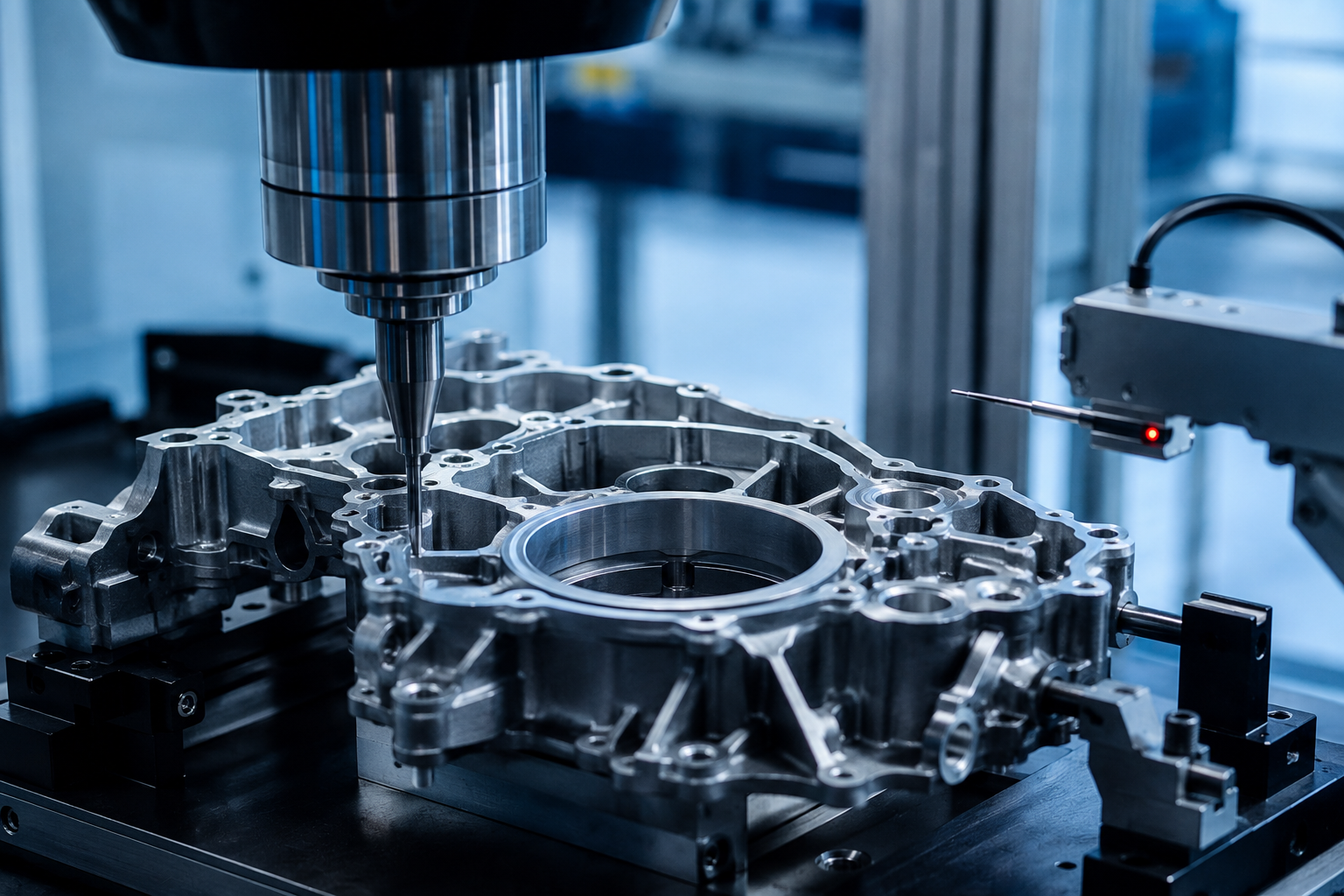
Precision, one tier back from the badge on the car.
At Jaguar Land Rover I rebuilt how the business planned and signalled demand to its own supply chain, revolutionising the Sales and Operations Planning process and the systems behind it, introducing early warning tools designed to catch a demand shift before it became a crisis rather than after. I built 36-month rolling capacity forecasts specifically so the supply base got the clearest, longest possible signal of what was actually coming, not the sanitised version that reaches a boardroom. I later worked across the order-to-cash architecture governing roughly £22 billion in annual revenue, the system through which every one of those planning decisions eventually became a supplier payment or didn't.
What that work teaches you, more than any strategy deck, is this. The entire discipline of S&OP and capacity signalling exists because an OEM's decision does not stay in the boardroom. It travels down through the supply base within weeks, sometimes days, and the only real question is whether the supplier gets a genuine early warning or finds out the same way everyone else does, when the order simply doesn't arrive. Good planning systems exist to give suppliers time to adjust. When they fail, or when the demand signal itself was wrong, a supplier absorbs the full, undiluted shock with none of the runway that early warning was supposed to buy them.
Every eye on European automotive right now is on the OEMs, VW's restructuring, Stellantis's fragmentation, Jaguar's collapse. All of it gets the headlines, because the OEM is where the strategy gets decided. But the supplier is where the strategy gets paid for, and it is paid for first, directly, and hardest.
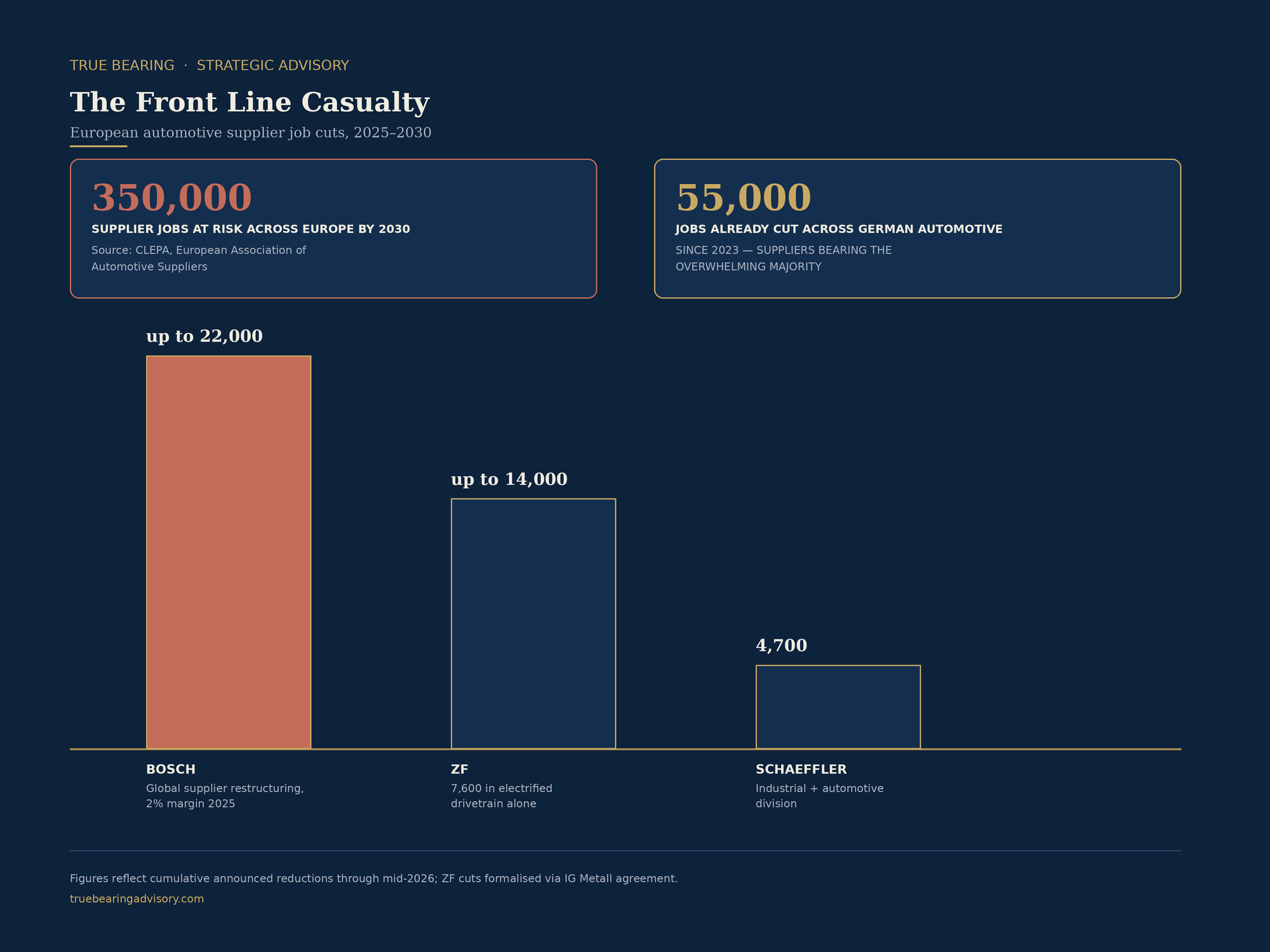
The Front Line Casualty — European automotive supplier job cuts, 2025–2030.
Start with Bosch, the largest automotive supplier in the world. In September 2025 it announced 13,000 job cuts in its mobility division, aiming to close a €2.5 billion cost gap. That was not the end of it. Bosch's 2025 operating margin in automotive collapsed to just 2%, and by May 2026 its own supervisory board chairman was citing up to 22,000 job cuts across the supplier business, framing the reductions in terms of the company's long-term survival, not a temporary correction. A cut of that scale is not what a 36-month rolling forecast is supposed to allow. It is what happens when the forecast itself turns out to have been wrong for longer than anyone was willing to admit.
ZF Friedrichshafen tells an even more precise version of the same story, and the mechanism matters as much as the number. ZF has agreed with its own union, IG Metall, to cut up to 14,000 German jobs by 2030, with 7,600 of those falling specifically inside its electrified drivetrain division. ZF is shutting down capacity it built for pure electric vehicles and pivoting toward plug-in hybrid development instead, a direct, checkable admission that the BEV volume its customers signalled was never going to arrive on the timeline anyone was planning around.
There is a quieter mechanism worth naming precisely, because it is easy to underestimate next to a large headline number. A headcount cut reduces labour cost. A model lineup cut reduces something far more consequential for a supplier, the actual number of distinct parts, tooling programmes, and component contracts sitting on that supplier's own order book. When an OEM reduces its range from roughly 150 models to under 100, as Volkswagen has just signalled it will do, every discontinued model takes its entire bill of materials with it, every bracket, harness, casting, and control unit built specifically for that platform. A supplier doesn't lose revenue because an OEM has fewer employees. It loses revenue because an entire programme it built capacity around simply stops existing. This is arguably a harder hit than a workforce number, and it is currently the least dramatic-sounding of the pressures bearing down on the supply base, which makes it the one most likely to be underestimated by anyone reading only the headlines.
CLEPA, the European Association of Automotive Suppliers, puts the number now at risk across the entire sector at 350,000 jobs by 2030. Roughly 55,000 have already gone across Germany's automotive industry since 2023, and suppliers have absorbed the overwhelming majority of that reduction, not the OEMs whose decisions caused it.
A note on timing, as of 28 July 2026. Volkswagen's own restructuring is unfolding in real time as this is written. Its supervisory board rejected a proposed 100,000-job, four-plant cut on 9 July. In its place, VW announced it will reduce its model lineup by up to 50%, from roughly 150 models to under 100, which is precisely the mechanism described above. Separately, VW's advisers are reportedly pushing the board to consider selling Ducati outright or taking Lamborghini public to raise capital, following a stronger-than-expected valuation on the recent sale of its marine engine business. None of this is resolved. Any of the three outcomes, workforce cuts, model rationalisation, or the sale of a flagship brand, lands as a direct hit somewhere in the supply base described in this chapter, and the situation may well have moved again by the time you read this.
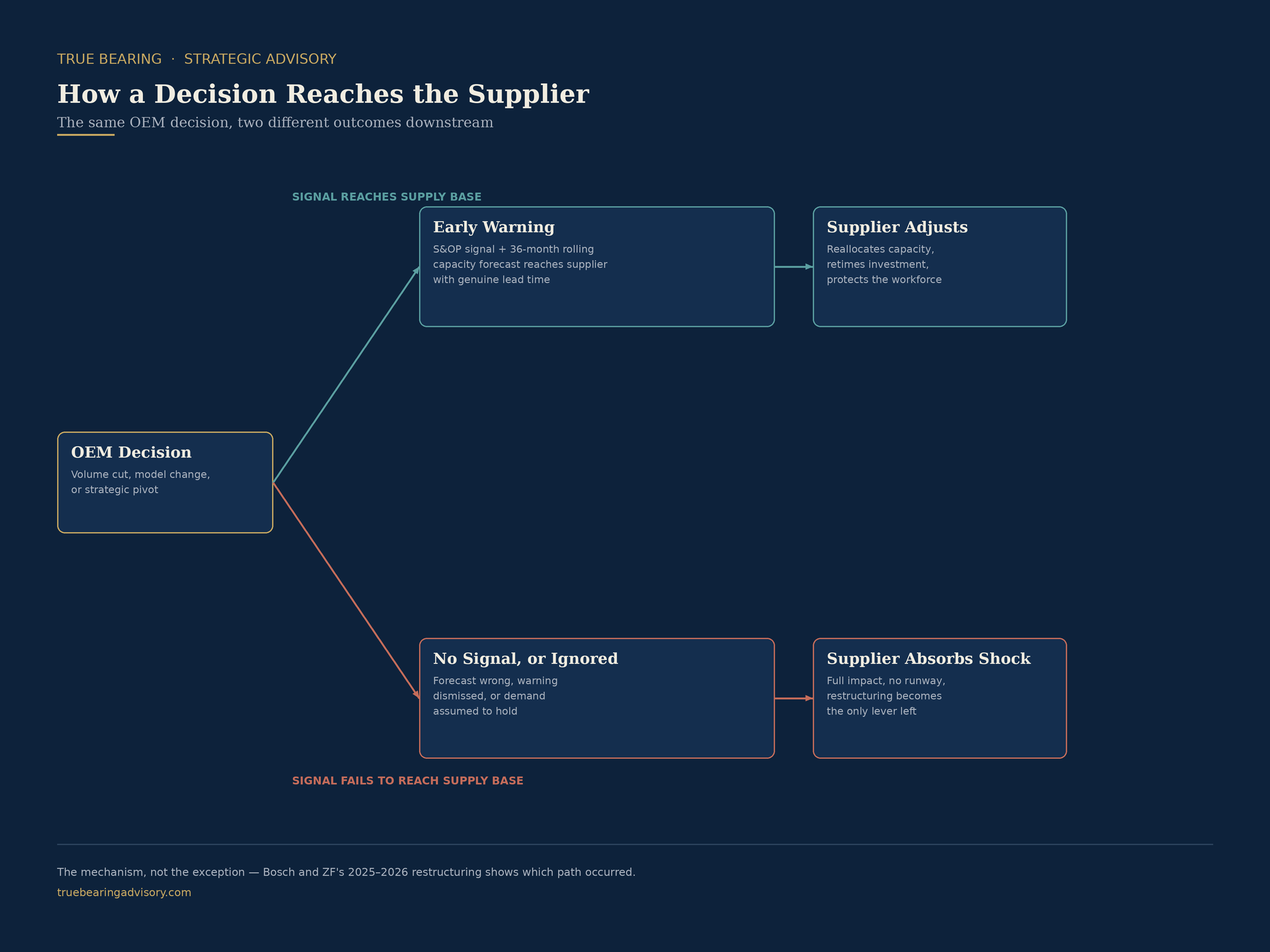
How a decision reaches the supplier — the same OEM decision, two different outcomes downstream.
There is a second pressure compounding the first, and it is genuinely new information for anyone still thinking of this purely as an OEM demand problem. Bosch and ZF have both explicitly cited competition from Chinese suppliers, not just Chinese OEMs, as a direct factor in their restructuring. Bosch's own reporting named BYD specifically. No early warning system, however well built, can signal a competitor undercutting you on cost from a different continent entirely, that pressure doesn't travel down through the OEM relationship at all, it arrives sideways, directly into the supplier's own order-to-cash reality. This means the Chinese offensive discussed elsewhere in this series is not confined to the showroom. It is happening one tier back, inside the component and systems business that Bosch and ZF have dominated globally for decades.
This is where Chapter Two's ‘mentor’ concept becomes relevant again, but with an important difference. Bentley and Rolls-Royce have patient, deep-pocketed parents absorbing the cost of a bad year long enough for the brand to compound. Suppliers, even the largest and most sophisticated ones, generally do not have that. Bosch's private, foundation-owned structure gives it more room to restructure on its own terms than a publicly listed supplier would have. ZF does not have that same insulation, and its restructuring, forced through a union agreement rather than chosen at leisure, shows what happens without it.

The signal was always there. The question was whether anyone read it.
None of this is abstract for the capital watching this sector. A component-level order book collapsing, a Tier 1 walking back its own technology roadmap, and a workforce reduction now measured in the hundreds of thousands rather than the thousands, this is exactly where distressed debt, carve-out, and restructuring capital should already be active, and in several cases already is. Every figure in this piece exists inside a real order-to-cash system somewhere, revenue that was forecast, planned for, and did not arrive. The suppliers are not a footnote to the OEM story. They are the leading indicator that the OEM story is real, structural, and already being paid for in cash, not just in headlines.
Next in this series: the retail networks absorbing the same pressure from the opposite direction, the indirect cost of every one of these decisions, arriving at the point of sale long after the supplier has already felt it.
If this pattern is already playing out inside your own organisation, market, or portfolio, I'd welcome the conversation. truebearingadvisory.com
Balázs Roóz
Founder, True Bearing Advisory
Strategic Advisory · Munich & Limassol