

The Survival Paradox
Thin air above, bloodbath below, and three different bets on staying alive in between.
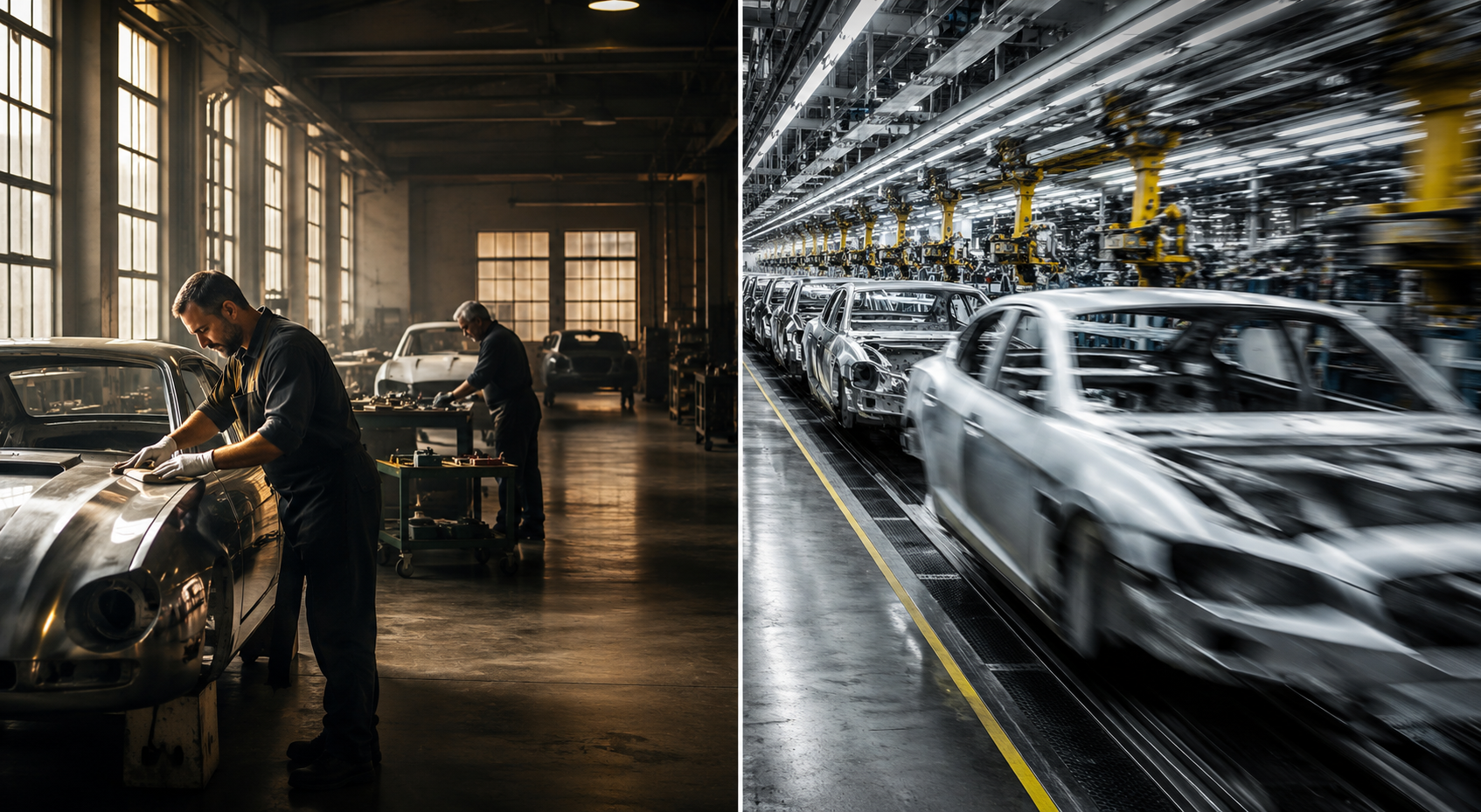
Thin air above. Bloodbath below.
I have run both sides of this industry's current split personally, not as an observer. At Bentley, scarcity is the strategy. Fewer cars, more margin, a customer who appreciates value rather than negotiates on it. Two of Bentley's most profitable years in its history happened during the worst supply chain disruption the industry has seen in a generation. At Jaguar Land Rover, I ran the opposite model, global sales operations and the sales director role for Europe, across 140+ markets, where scale is the strategy and every percentage point of share has to be fought for against three German rivals who already had it.
Every OEM in Europe currently wants to be closer to the first model than the second. Margin per unit in true luxury dwarfs anything achievable at volume, and BMW and Mercedes are both visibly tilting upmarket rather than fighting for share in a segment being hollowed out from below. The instinct is rational. What it misses is the part that makes this genuinely dangerous rather than simply attractive.
Building and sustaining a true luxury brand does not cost less than building a volume one. It costs roughly the same, in engineering, in technology, in the industrial base needed to actually manufacture the thing to the standard the price implies, and that cost is then spread across a fraction of the units. A volume manufacturer can absorb a bad model year. A luxury manufacturer usually cannot, because there is no scale to dilute the mistake into. That is the real shape of thin air. It is not a safer place to stand. It is a place where the stakes on every single decision are magnified, because the volume that would normally cushion an error simply is not there.
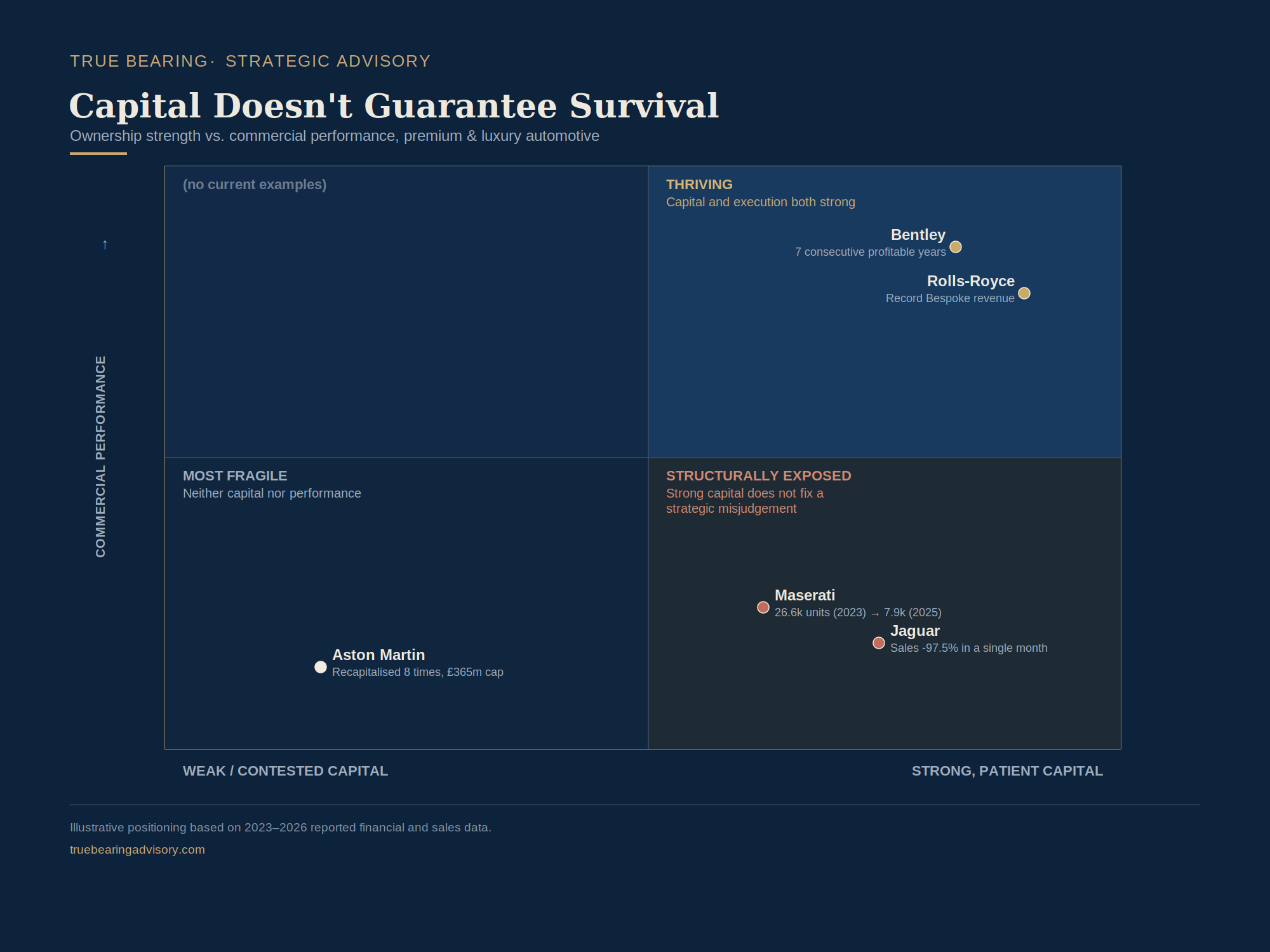
Capital doesn't guarantee survival - ownership strength vs. commercial performance.
This is why patient, deep-pocketed backing is not a nice-to-have in this segment, it is close to existential. Bentley and Rolls-Royce thrive under VW and BMW specifically because those parents fund the financials, the technology, and the industrialisation through the inevitable rough years, the way VW carried Bentley through a $157 million loss in 2018 on the way to seven consecutive profitable years since, including 2025 itself, though that year also brought a 5% drop in deliveries and 275 planned job cuts, the first real sign of strain in the run. Aston Martin is the clean counter-example. Repeatedly recapitalised, market capitalisation down to roughly £365 million, Geely holding a 17% stake and a board seat but so far unwilling to become the mentor the brand actually needs. The clearest evidence came this July, when Aston Martin turned not to Geely but to private credit funds including BlackRock-owned HPS for a structurally aggressive drop-down financing, ring-fencing assets beyond existing creditors’ reach, prompting a rival creditor group to mobilise against the deal. Aston Martin is failing because nobody has been willing or able to be the mentor that Bentley and Rolls-Royce both have, the backer who absorbs the mistakes long enough for the brand to compound. Without that, in a segment where mistakes are not diluted by volume, you do not fail quickly. You simply never move the needle.
Maserati sits somewhere between the two. A parent with real capital, Stellantis, but visibly hedging rather than committing, in talks with Huawei and JAC on the brand's future even as it denies Maserati is for sale. Sales down from roughly 26,600 units in 2023 to 7,900 in 2025, a 70% collapse in two years and the brand's lowest total since 2012. Half-scarcity is not a strategy. It is what happens when a capable parent has not yet decided whether to be the mentor a luxury brand actually needs.
Underneath all of this sits a second, harsher reality for anyone who stays in mainstream or mass-premium rather than making the move upmarket. That tier gets none of thin air's pricing power and none of true volume's scale efficiency. It is exposed on cost, exposed on margin, and increasingly contested by Chinese brands moving directly into its territory. Nio, Zeekr, and Xpeng are now building specifically for the executive and D-segment bracket that BMW, Mercedes, Audi, and Jaguar have occupied for decades, not just undercutting on price but competing on genuine technology and cabin experience.
Jaguar's own collapse this year shows what happens when a brand sitting in that exposed tier adds a serious strategic misjudgement on top of it. Sales fell 97.5% in April 2025 after Jaguar discontinued nearly its entire model range ahead of a rebrand and an electric relaunch now delayed into 2026, a self-inflicted wound, not a Chinese one, but one that landed with maximum damage precisely because the tier it happened in was already exposed and offered no scale to absorb the mistake. JLR has since cut its full-year EBIT margin guidance twice, first to 5–7% on US tariffs, then to 0–2% after a cyberattack halted production for weeks in September, down from an earlier 10% target and below FY25's actual 8.5%, with free cash outflow now guided at £2.2–2.5 billion rather than merely close to zero, driven by US tariffs, the cyberattack, the Jaguar wind-down, and rising capital expenditure.
The XE itself shows the underlying mechanism in miniature, and it predates this year's crisis by a decade, worth naming precisely because it is a single, checkable fact rather than an argument. Jaguar built its case against the German three around lightweight aluminium engineering, 75% aluminium body content against their steel construction. Independent road tests found the XE came out heavier than the BMW 3 Series it was designed to beat, 1,610kg against a lighter steel-bodied rival. That landed at the exact moment European CO2 regulation made every kilogram a direct, quantifiable cost. Complacency, in a tier with no room left to absorb it, long before this year's rebrand made the exposure fatal.
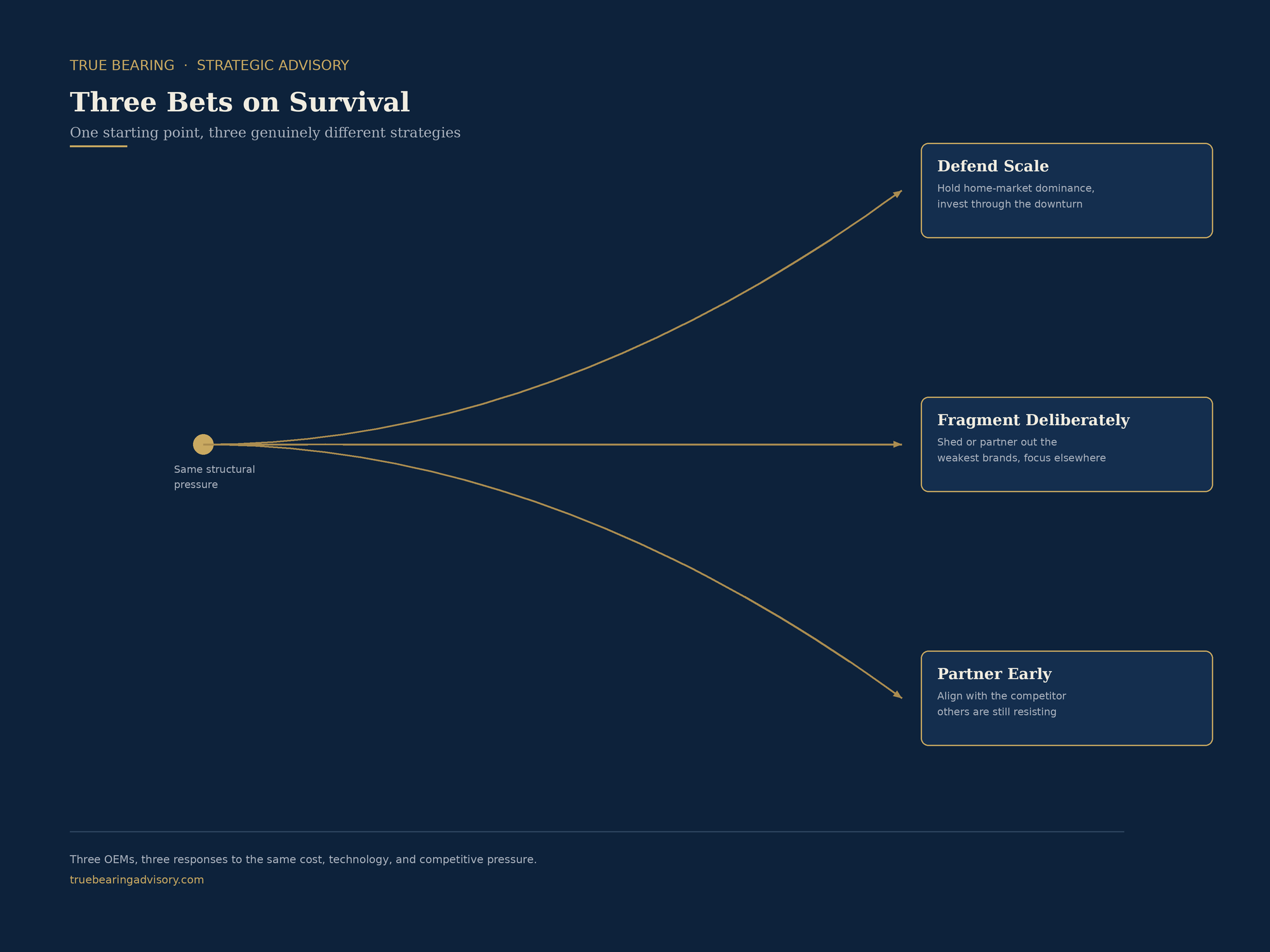
Three OEMs, three genuinely different bets on survival.
This is the fork VW, Stellantis, and Renault are each answering differently, and it is worth naming precisely because it is not three equally weighted options, it is three different bets on where the least bad risk sits. VW is defending scale, betting that home-market dominance and sheer size still buy enough time and enough volume to fund the transition without needing to retreat upmarket or partner out. Stellantis is fragmenting deliberately, the Dongfeng joint venture, the Maserati conversations, a €60 billion FaSTLAne 2030 plan, essentially choosing which parts of its portfolio get the mentor treatment and which get shed or partnered away rather than trying to defend everything at once. Renault, the smallest of the three with no meaningful US or China footprint, is doing the boldest thing, leaning into Geely as a genuine growth partner rather than treating Chinese capital purely as a threat, effectively borrowing someone else's capacity to be a mentor rather than trying to build that capacity alone.
One quiet data point worth holding for later in this series. Commercial and industrial vehicles, Scania and AB Volvo's trucks division specifically, have proven considerably more resilient through this same period than passenger cars have, a genuinely different competitive dynamic worth remembering when the passenger car headlines feel universal.

Three bets, one curve. The pattern doesn’t pick a winner.
None of this is a ranking. It is three organisations making three different bets about where the real risk sits, thin air's magnified stakes on one side, mass-premium's direct exposure to a genuine Chinese offensive on the other, and precious little safe ground in between. What Bentley, Rolls-Royce, and now MINI share is not a category, premium versus volume was never really the axis that mattered. What they share is a mentor patient enough to fund the mistakes a low-volume, high-cost business will always make. Aston Martin lacks that. Jaguar has it and is still struggling, because a mentor buys you the capital to survive a misjudgement. It does not buy you the judgement itself.
Next in this series: the suppliers absorb the direct cost of every one of these decisions, before any of it reaches a customer at all.
If this pattern is already playing out inside your own organisation, market, or portfolio, I'd welcome the conversation. truebearingadvisory.com
Balázs Roóz
Founder, True Bearing Advisory
Strategic Advisory · Munich & Limassol